














AVİM Analyst Hazel Çağan Elbir recently published a detailed reaction to a very unfortunate article of Agos—an article mythologizing the hostage taking at the Ottoman Bank by members of the Armenian Revolutionary Federation (ARF-the Dashnaks) on 26 August 1896. In the Agos article, the attack is isolated from its context (a series of bloody terrorist operations in Istanbul) and is reduced to its supposed political message. Çağan Elbir’s response also exposes who Monte Melkonian (a more recent but equally mythologized terrorist) was. All these aspects are well documented in Çağan Elbir’s work, however, some more elements can be added on this issue.
The Attack against the Ottoman Bank: A Part of a Scheme of Creating Tension and Provocation
The murderous consequences of the attacks was the desired outcome of the terrorist actions carried out by ARF. Gaston Auboyneau (1865-1911) was the deputy general director of the Ottoman Bank at that time. He took notes during and right after the hostage taking. For unknown reasons, these notes were published only after his death. In any case, they are a particularly valuable source. Auboyneau explains that after the end of the hostage taking, the employees of the bank found “45 spherical bombs bristling with capsules, 25 cylindrical sticks of dynamite”, a bag of “11.4 kg” of dynamite, and plenty of revolvers and cartridges—in other words, the threat to blow up the building was serious.[1]
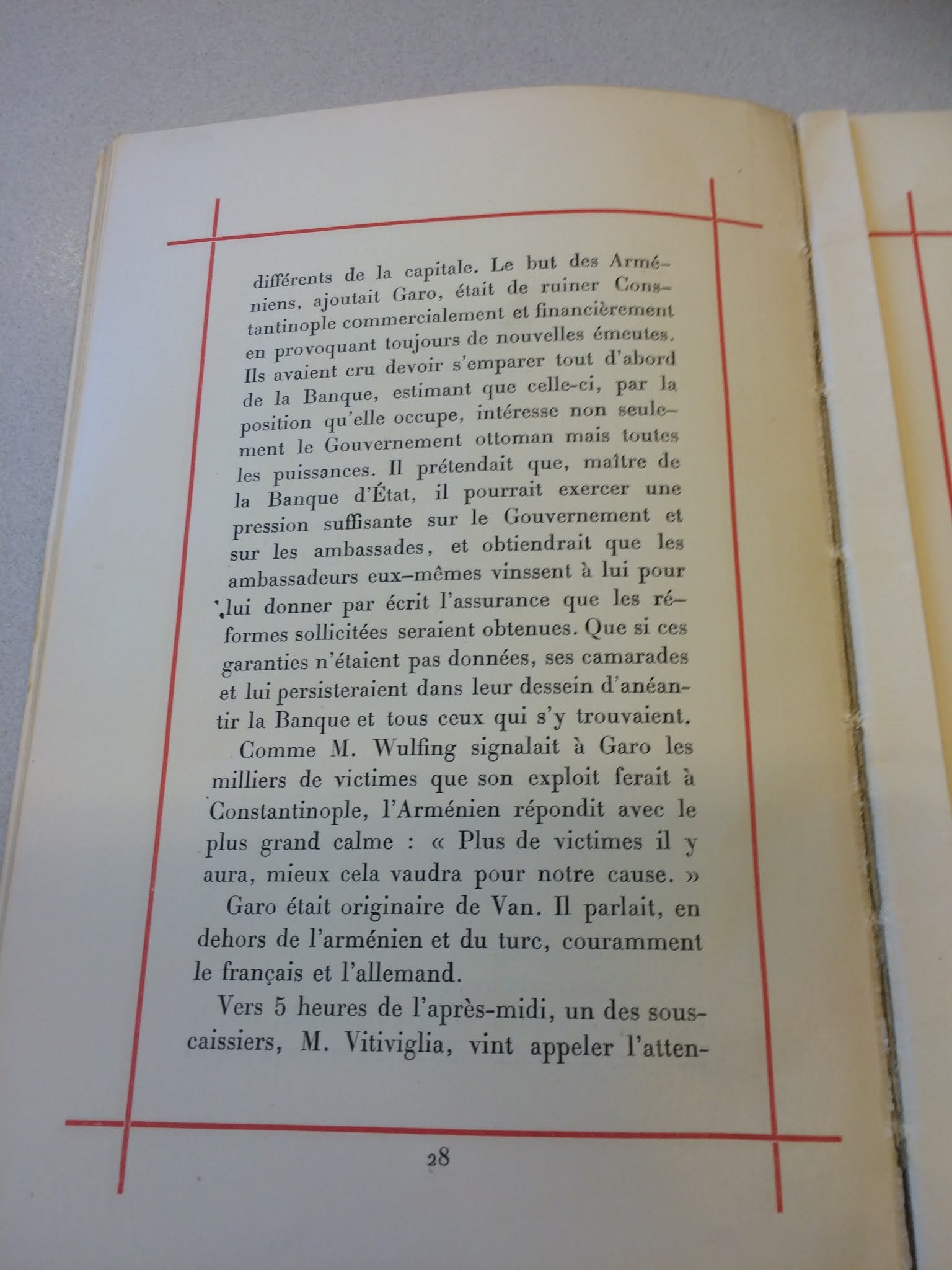
Even more remarkably, Auboyneau writes that Garegin Pasdermadjian, also known as Armen Garo (1872-1923), spoke with one of the officers of the Bank, Gustav Wülfing:
“[…] The revolt had broken out on seven different points of the capital city. The Armenians’ goal, Garo added, was to ruin Constantinople [İstanbul] commercially and financially by constantly inciting new riots. They had deemed it necessary to seize the Bank first, believing that, given its position, it was a matter of concern not only to the Ottoman government but to all the powers. He claimed that, once in control of the State Bank, he could exert sufficient pressure on the [Ottoman] government and the embassies [of the foreign powers] to compel the ambassadors themselves to come to him and provide written assurances that the requested reforms would be granted. If such guarantees were not forthcoming, he and his comrades would persist in their plan to destroy the Bank and everyone inside it.
When Mr. Wulfing pointed out to Garo the thousands of casualties his exploit would cause in Constantinople, the Armenian replied with the utmost calm: ‘The more victims there are, the better it will be for our cause.’”[2]
Similarly, another officer of the Bank, “Barker, who spent several hours with them, found them happy to learn that there had been many victims. ‘The more deaths there are, the more blood is shed, the closer we will be to the success of our cause, for Europe will be forced to intervene.’”[3]
All these observations are confirmed by other sources. Inspector Lefoulon of the Parisian police, who was visiting his uncle (working for the Ottoman government) during his summer holidays, reported, at the request of his hierarchy, about the hostage taking as well as about the other attacks: A bomb killed two soldiers and wounded twenty-five in Péra (Beyoğlu), another bomb was hurled (in vain) to assassinate the Şey-ül İslam (the highest religious Muslim authority of the Ottoman Empire), ARF terrorists attacked 250 soldiers before committing suicide, new bombs exploded on 28 and 30 August 1896 (after the end of the hostage taking), etc.[4] The report of the Ottoman investigative commission is, of course, congruent with the Lefoulon one.[5]
It has been well established for 95 years, thanks to the publication of internal Russian documents, that the Russian government seriously considered an invasion of the Turkish Straits in 1896-1897, after a similar project in 1895 was vetoed by the French government. The second project failed because of the opposition of France and Austria-Hungary, because of divisions in the Russian state itself on the conduct to adopt, as well as because of difficulties of the Tsar’s government in the Far East.[6] In other words, the ARF’s hope for a foreign intervention was not chimerical, even if it was a risky bet. The intention of ARF to spread blood is also confirmed by its very strong implantation among the Armenian workers of the lowest category,[7] namely those who were in direct economic concurrence with the Kurds and Laz. Concurrence between workers could be particularly violent at that time, at least if added to a national or ethnic conflict, as proved, for example, the anti-Italian riot of Aigues-mortes in August 1893.[8]
This is even clearer when considering the clashes deliberately provoked by the Social Democrat Hunchakian Party (the Hunchaks - another Armenian nationalist party) in 1894 (100 fighters and about 50 civilians killed on the Armenian side, an unknown number on the Muslim side)[9] and even more in several locations of Anatolia in Autumn 1895, particularly those having a strong Kurdish or Laz population (thousands of killed on both sides).[10] Provoking murderous reprisal was a strategy announced by the Hunchaks as early as 1893.[11] Like the Hunchaks, the Dashnaks knew exactly what they were doing. The Dashnaks had organized a revolt in and near Van in June 1896, but the expected foreign intervention (Russian, for example) did not happen.[12] From this failure, the Dashnaks concluded that something more spectacular had be tried.
Another key aspect is the aim pursued by the ARF (the Dashnaks) to justify the sacrifice of thousands of innocents. Were the Ottoman Armenians a persecuted minority? Definitely no. Agop Kazazyan Paşa was the Ottoman sultan Abdülhamit II’s Minister of the Civil List (namely in charge of the imperial domains) from 1880 until his death in 1891. He cumulated this position with the one of Minister of Finances in 1886-1887 then from 1888 to 1891.[13] He was succeeded as Minister of the Civil List by another Armenian, Mikael Portakalian Paşa, in office from 1891 to 1897. Beyond these individual cases, 20% of the best paid officials of İstanbul were Armenians in 1896,[14] as were 14% of the personnel at the Ottoman Ministry of Foreign Affairs in 1895,[15] including Artin Dadyan Paşa, General Secretary of the Ministry from 1883 until his death in 1901.
Russian General Mayewski, who served as consul general in Van then in Erzurum during the 1890s, noticed, in a report to his hierarchy (published only twenty years later) that the urban Armenians had no credible grievances to present in the Ottoman Empire, that the Armenian peasants certainly suffered of attacks by nomadic Kurds but not more than the sedentary Kurds, and that they were wealthier than the Turkish and Kurdish peasants.[16] During the 1870s, 1880s, and 1890s, Armenians (and Greeks) established their own trading houses, instead of merely working for Western European companies, a change causing a true “golden age” for the Armenian and Greek bourgeoisie, and this was the case not only in coastal cities, but also in Central Anatolia.[17]
So, ARF’s aim was not to protest against injustices, but to establish, by paroxysmal violence, an Armenian state on Ottoman territories where the Armenians were in minority everywhere.[18]
ASALA’s False Flag Attacks on Armenian Targets During the Melkonian Years and the Despise Shown against Turkish Armenians
On 28 November 1986, during the trial of Monte Melkonian for conspiracy, illegal possession of explosives and weapons, and illegal possession of a fake passport, the presiding judge read publicly internal documents of the Armenian Secret Army for the Liberation of Armenia (ASALA) seized during the arrest of Melkonian a year before. A part of these documents proved that ASALA perpetrated attacks, some of them murderous, against Armenian targets in and near Paris, under false flag (an imaginary “Turkish Islamic Army”), “to mislead the Armenian community and to provoke an extreme anti-Turkish reaction” (these are the words of ASALA). Among these attacks, the bombing of a cultural center in Paris in May 1981 and a Armenian Apostolic (Gregorian) church in Issy-les-Moulineaux (Parisian suburb) a month later.[19] The choice of civilian targets in Türkiye, such as the Ankara Esenboğa Airport (failed bombing in August 1979, mass shooting in August 1982) or the Bazaar of İstanbul (shooting of June 1983)[20] hardly leaves any doubt about the intent, including during the Melkonian years (he broke up with ASALA in July 1983), to provoke a remake of the violence of the 1890s.
Despite his conviction, the revelations mentioned above, and the later revelation that he was the assassin of Neslihan Özmen (14 years old) in 1980,[21] Melkonian is considered a “hero” by a significant part of the Armenian Diaspora. The Union of the Armenians of Moscow commemorates him as such. The Armenian Report (Los Angeles) defends the same position. In July 2026, it was announced that a statue of Melkonian would be erected in Fresno, California/the US.
It is also worth noting that the first attack perpetrated by ASALA took place in January 1975 (against a non-Turkish target: the World Council of Churches),[22] namely when Türkiye was a parliamentarian democracy in the Western camp of the Cold War years. In contrast to Türkiye, ASALA was openly pro-Soviet, as it is visible in its manifesto published in 1978.[23] ASALA terrorists while on trial in Paris in January 1984 for a murderous hostage taking at the Turkish General Consulate gave Soviet Armenia as an example to follow[24]—at a time when the said country was subjected to a totalitarian dictatorship under the Soviet Union. In other words: ASALA never fought for any kind of “liberty” or “liberation”. The “L” in the organization’s name was as false as the false flag bombings it carried out.
Before the first attack by ASALA properly speaking, Agop Binyat, a Turkish Armenian lawyer, reacted to the double assassination perpetrated by Gourgen Yanikian (the inspiration for ASALA)[25] as follows in Cumhuriyet, 22 February 1973:
“This has hurt me beyond expression. The sincerity of my grief will, I am sure, be attested by my colleagues with whom I have worked in the course of the 27 years of my political career; the members of the Istanbul Bar Association, where I have been registered for the last 24 years; the distinguished members of the Istanbul judiciary; the community of the Istanbul Municipal Council which I have served as a member during the mayorship of the late Haşim İşcan; and all the others I have known.”
He was not an isolated case. Arman Manukyan (1931-2012) was a professor at the Bosphorus University and a member of the delegation sent to Washington DC by TÜSİAD (union of Turkish businesses) in 1975, in order to negotiate the end of the American embargo on arms adopted (against the will of the Richard Nixon administration) by the Congress in 1974. Kevork Acemoglu (1938-1988; the father of economist Daron Acemoglu) was a professor at the same university and he wrote an article for Milliyet on the history of Turkish-Armenian relations (including the tragedy of 1915-16) in 1970. Although Acemoğlu Sr. was a notorious figure of the Turkish left, the Idealist Hearths (Ülkü Ocakları, Turkish nationalist right) gladly reprinted his article.
Avedis Simon Hacinliyan, at that time Associate Professor at Bosphorus University, testified as a plaintiff’s witness for the trial of the Orly Airport attack in France. He explained that, after having completed his Doctorate in Physics at the University of Chicago, he returned to Türkiye, while he could have worked abroad. At the Bosphorus University, he served as acting chairman of the Department of Computer Science. He served in the military, and more precisely at the Research and Development section of the Ministry of National Defense, from 1973 to 1975, namely during the Cyprus Crisis of 1974. Three other reserve officers served in this section at that time, including an Armenian, Dr. Hacinlyan. Hacinlyan also taught at the Middle East Technical University (METU), Black Sea Technical University, Çukurova University, and Kocaeli University. He was among the 19 non-Muslim faculty members in his university alone, and several others at METU, Istanbul University, and Trakya University (Edirne). He also pointed out that “the members of the Armenian community are economically in a better shape than the average citizen of İstanbul or Turkey [Türkiye] as a whole.”[26]
Correspondingly, in 1981, two reporters of the French state TV observed, during their coverage of the Istanbul Armenians, that “financially, they seem very well-off” and that the newspaper Jamanak, a Turkish Armenian newspaper dating back to the Ottoman times, was published without difficulty, while Armenian churches and schools continued their activities normally.
Conclusion
All these elements confirm that the stance adopted by the newspaper Agos is a form of nationalism imported from the militant-radical elements of the Diaspora and Armenia, in contradiction to the tradition of the Turkish Armenians that traces its roots to the brightest elements of the Ottoman Armenian community and with the policy recently adopted by Armenian Prime Minister Nikol Pashinyan. Regrettably, Agos’ imported nationalism serves no constructive purpose in terms of justice or truth.
*Image: Gaston Auboyneau’s notes on the attack carried out against the Ottoman Bank and the stance of Garegin Pasdermadjian (Armen Garo) regarding the attack.
[1] Gaston Auboyneau, La Journée du 26 août à la Banque impériale ottomane, Villeurbanne, Imprimerie Chaix, 1912, p. 26.
[2] Ibid., pp. 27-28.
[3] Ibid., p. 34.
[4] Rapport de l’inspecteur Lefoulon, 17 septembre 1896, Archives de la préfecture de police de Paris, Le Pré Saint-Gervais, BA 2146.
[5] Osmanlı Belgelerinde Ermeni İsyanları, Ankara, 2008, volume III, pp. 5-45.
[6] İhsan Çomak, “19. yy. Sonunda Rusya’nın Osmanlı Devleti Politikası ve Rusya Karadeni Donanması Kaptanı Lev Brusiolv’un Gözüyle Rusya’nın İstanbul Büyükelçisi A. İ. Nelidov,” Karadeniz Araştırmaları, n° 47, Güz 2015, pp. 39-52; William Langer, The Diplomacy of Imperialism, New York: Alfred A. Knopf, 1960, pp. 205-208 and 330-349.
[7] Muammer Demirel (ed.), British Documents on Armenians (1896-1918), Ankara, Yeni Türkiye, 2002, p. 214.
[8] Enzo Barnabà, Le Sang des marais : Aigues-Mortes, 17 août 1893, une tragédie de l'immigration italienne, Marseille, Via Valeriano, 1993 ; Pïerre Milza, Voyage en Ritalie, Paris, Payot & Rivages, 2004, p. 136.
[9] Justin McCarthy, Cemalettin Taşkıran and Ömer Turan, Sasun, Salt Lake City: University of Utah Press, 2014 (analysis of the Armenian mortality pp. 151-155 and 186-188).
[10] Jeremy Salt, Imperialism, Evangelism and the Ottoman Armenians. 1878-1896, London-Portland, Frank Cass, 1993, pp. 95-106.
[11] William Langer, The Diplomacy of…, pp. 157-158.
[12] Justin McCarthy, East Arslan, Cemalettin Taşkıran and Ömer Turan, The Armenian Rebellion at Van, Salt Lake City: University of Utah Press, 2006, pp. 62-68.
[13] Elif Yeşiltepe Turşucu and Selma Ye, “Osmanlı Maliyesinde Radikal Reformların Arkasındaki Maliye Nazırı: Agop Kazazyan Paşa (1886-1891),” in Yunus Pustu, Ayşenur Şenel and Hande Yaren Karacabey (ed.), Türkiye İktisat Kongresi Bildiriler Kitabı, 19-20 Temmuz 2023, Ankara: Türk Tarih Kurumu, 2024, pp. 715-738.
[14] Sidney Whitman, Turkish Memories, New York-London: Charles Schribner’s Sons/William Heinemann, 1914, p. 19.
[15] Carter Vaughn Findley, Ottoman Civil Officialdom: A Social History, Princeton, NJ: Princeton University Press, 1989, p. 96.
[16] General Mayewski, Les Massacres d’Arménie, 1916, pp. 8-11.
[17] François Georgeon, Abdülhamid II, le sultan-calife, Paris : Fayard, 2003, pp. 321-322.
[18] Francis de Pressenssé, « La question arménienne », Revue des deux mondes, 1er décembre 1895, p. 677.
[19] Laurent Greilsamer, « Les archives sanglantes du terrorisme arménien », Le Monde, 1er décembre 1986.
[20] Michael M. Gunter, “Pursuing the Just Cause of their People.” A Study of Contemporary Armenian Terrorism, Westport-New York-London: Greenwood Press, 1986, pp. 4, 43, 46 and 70; « Principaux attentats de l’Asala (et de ses sous-marques) 1975-1984 », Notes et études de l’Institut de criminologie de Paris, 1989.
[21] Christopher Gunn, Secret Armies and Revolutionary Federations: The Rise and Fall of Armenian Political Violence, 1973-1993, doctoral dissertation, Florida State University, 2014, pp. 221-222.
[22] Michael M. Gunter, “Pursuing the Just…”, p. 33.
[23] Armand Gaspard (Gasparian), Le Combat arménien, Lausanne: L’Âge d’homme, 1984, p. 71. The late Gaspard/Gasparian was an Armenian nationalist and by no means a friend of the Turks.
[24] « Quatre Arméniens devant leurs juges — Le Commando suicide Yeghin Kechichian répond de l'occupation sanglante du consulat de Turquie à Paris le 24 septembre 1981 », Le Monde, 23 janvier 1984.
[25] On the double assassination itself: Haluk Şahin, The Hate Trap: The anatomy of a forgotten assassination, İstanbul, Kirmizi Kedi Yayinevi, 2019.
[26] Terrorist Attack at Orly. Statements and Evidence Presented at the Trials. February 19 – March 2 1985, Ankara: University of Ankara, 1985, pp. 33-36 (quotation p. 36).
© 2009-2025 Center for Eurasian Studies (AVİM) All Rights Reserved
No comments yet.
-
ON THE LAST ATTEMPTS TO REHABILITATE ARF AND ASALA TERRORISM
Maxime GAUIN 28.09.2026 -
 THE COLLAPSE OF DASHNAK ARMENIA IN 1920 AND THE DEBACLE OF NIKOL PASHINYAN’S REGIME IN 2020
Maxime GAUIN 30.10.2020 -
 ARMENIA, THE 'BRANCH OF RUSSIA' IN THE SOUTH CAUCASUS
Maxime GAUIN 31.08.2015 -
 PATRICK DEVEDJIAN: A NEO-FASCIST WHO WAS A LIFE-LONG SUPPORTER OF TERRORISM
Maxime GAUIN 02.04.2020 -
 ROBERT FISK, BETWEEN FRANCOPHOBIA AND TURKOPHOBIA
Maxime GAUIN 19.11.2015
-
 THE CURRENT STATE OF RELATIONS BETWEEN KAZAKHSTAN-TURKEY
Özge Nur ÖĞÜTCÜ 13.09.2017 -
 THE EU’S FIRST SERIOUS CENTRAL ASIA INITIATIVE
Hazel ÇAĞAN ELBİR 15.04.2025 -
 THE SPECTER OF RENEWED ARMED CONFLICTS IN THE BALKANS
Teoman Ertuğrul TULUN 14.02.2017 -
 ARMENIAN TERRORISM BEGINS TO SHOW ITS FACE AGAIN
Hazel ÇAĞAN ELBİR 04.02.2021 -
 THE EUROPEAN PARLIAMENT’S RESOLUTION REGARDING THE 2014 PROGRESS REPORT ON TURKEY
Ali Murat TAŞKENT 17.06.2015
-
25.01.2016
THE ARMENIAN QUESTION - BASIC KNOWLEDGE AND DOCUMENTATION -
12.06.2024
THE TRUTH WILL OUT -
27.03.2023
RADİKAL ERMENİ UNSURLARCA GERÇEKLEŞTİRİLEN MEZALİMLER VE VANDALİZM -
17.03.2023
PATRIOTISM PERVERTED -
23.02.2023
MEN ARE LIKE THAT -
03.02.2023
BAKÜ-TİFLİS-CEYHAN BORU HATTININ YAŞANAN TARİHİ -
16.12.2022
INTERNATIONAL SCHOLARS ON THE EVENTS OF 1915 -
07.12.2022
FAKE PHOTOS AND THE ARMENIAN PROPAGANDA -
07.12.2022
ERMENİ PROPAGANDASI VE SAHTE RESİMLER -
01.01.2022
A Letter From Japan - Strategically Mum: The Silence of the Armenians -
01.01.2022
Japonya'dan Bir Mektup - Stratejik Suskunluk: Ermenilerin Sessizliği -
03.06.2020
Anastas Mikoyan: Confessions of an Armenian Bolshevik -
08.04.2020
Sovyet Sonrası Ukrayna’da Devlet, Toplum ve Siyaset - Değişen Dinamikler, Dönüşen Kimlikler -
12.06.2018
Ermeni Sorunuyla İlgili İngiliz Belgeleri (1912-1923) - British Documents on Armenian Question (1912-1923) -
02.12.2016
Turkish-Russian Academics: A Historical Study on the Caucasus -
01.07.2016
Gürcistan'daki Müslüman Topluluklar: Azınlık Hakları, Kimlik, Siyaset -
10.03.2016
Armenian Diaspora: Diaspora, State and the Imagination of the Republic of Armenia -
24.01.2016
ERMENİ SORUNU - TEMEL BİLGİ VE BELGELER (2. BASKI)
-
AVİM Conference Hall 24.01.2023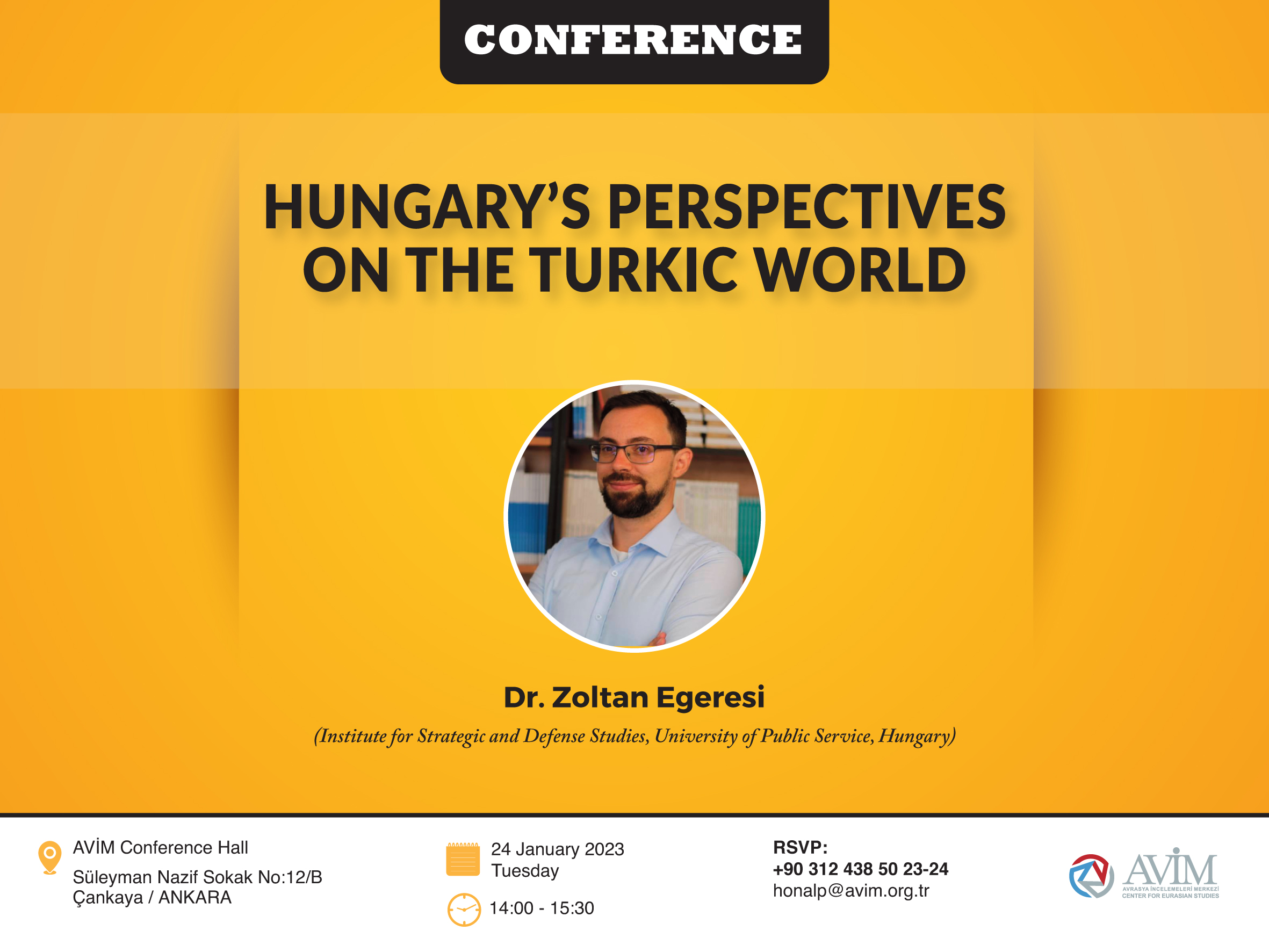
CONFERENCE TITLED “HUNGARY’S PERSPECTIVES ON THE TURKIC WORLD"