














Introduction
It is a historical fact that Greece systematically exterminated Turks and Muslims in the Balkans region and Anatolia during and after its independence from the Ottoman Empire. The philhellenes of Western countries have always tried to ignore this reality, and they covered up the crimes that had been committed, causing them to be forgotten. In fact, one of the bloodiest examples of this systematic extermination is the 1821 Tripolitsa massacre against the Turks in the Peloponnese Peninsula when Greece gained its independence from the Ottoman Empire.[1] Tens of thousands of Turks and Muslims were brutally murdered in this massacre, and Western countries remained silent about this barbaric act. Nevertheless, although their numbers were limited, there were soldiers and academics from Western countries who spoke out against these brutal massacres and took a stand. For instance, an eminent British historian, William St Clair, in his 1972 book, refers extensively to the fate of the Turks during the 1821 Greek rebellion. He states that the Turks, who constituted a considerable population in Greece in 1821, disappeared suddenly and in large numbers in the spring of 1821, and that the rest of the world ignored their disappearance. When criticizing this pretended ignorance, he explained his sadness and stated that the Turks "were killed deliberately, without qualm or scruple, and there were no regrets either then or later." Despite the strong presence of philhellenes, who constantly spread hatred against Turks in society and academic circles, it is admirable that William St Clair wrote this atrocity against the Turks openly and boldly in 1972. This is actually a fair approach, but it is also a profoundly brave move in the face of the financial and political influence of the philhellenes in academia. Roderick Beaton, a Korea Professor of Modern Greek and Byzantine History, Language and Literature at King's College London, in the introduction to the 2008 edition of William St Clair's book, pointed to this courage. He noted that while St Clair's remarks about Greek atrocities against the Turks might offend "armchair philhellenes" and Greek readers accustomed to standard Greek national historiography, St Clair dared to reflect this disturbing fact. As per Beaten, St Clair’s book deals with a vast cast of characters, from the familiar names of political leaders and more or less celebrated individuals, such as Byron, to a host of unsung and mostly fairly unheroic foreign volunteers and Greeks of contrasting backgrounds. He asserts that William St Clair is not shy about pointing out the follies of individuals, the unscrupulousness of governments and their agents, and offering judgment when he deems it appropriate. He also points out that drawing on often horrific firsthand accounts by foreign philhellenes, he balances the often-told tale of Turkish atrocities perpetrated upon Greek Christians with evidence for equally brutal and equally indiscriminate behavior on the Greek side.[2]
As noted in the aforesaid academic works, Greek bands, under the pretext that they were collaborating with the Turks, also subjected the Jewish subjects of the Ottoman Empire living in the region at the time to torture and extermination. In fact, the massacres committed against the Turkish population since the founding of Greece are not limited solely to the massacre at Tripolitsa. There are numerous academic studies documenting these massacres, authored by Western writers who held an admiration for Greece.
One such work is a classic 19th-century seminal two-volume work of “History of the Greek Revolution” published in 1861 by George Finlay, a Scottish philhellene and historian who fought alongside Lord Byron during the Greek “War of Independence." Despite his deep personal dedication to the cause of Greek independence, Finlay approached his historical accounts with critical liberalism and intellectual rigor. He explicitly framed the initial stage of the uprising as a deliberate, systematic "war of extermination" aimed at clearing the Peloponnese of its Turkish Muslim inhabitants. Finlay noted that the extermination was not an accidental byproduct of chaotic skirmishes, but rather a calculated strategy. He observed that the Greek leadership and revolutionary bands operated under the shared understanding that the revolution's success depended on the complete removal of the Turkish presence. The information provided below, taken from a section titled "The Extermination of the Turks" in the book written by Finlay 165 years ago, in 1861, in fact, vividly illustrates the ruthless manner in which Turks were annihilated during the Greek uprising:
“In the mean time the Christian population had attacked and murdered the Mussulman population in every part of the peninsula. The towers and country houses of the Mussulmans were burned down, and their property was destroyed, to render the return of those who had escaped into fortresses hopeless... They inculcated the necessity of exterminating every Turk, because the Turkish population in Greece was small, and could not be renewed. The slaughter of men, women, and children was therefore declared to be a necessary measure of wise policy, and popular songs spoke of the Turks as a race which ought to disappear from the face of the earth.” [3]
Another English historian and specialist in 19th-century European history, W. Alison Phillips, in his 1897 book “The War Of Greek Independence 1821 -1833,” describes massacres against the Turks. He cites that “... The Morea shall no Turk be left, Nor in the whole wide world. Thus rang the song which, from mouth to mouth, announced the beginning of a war of extermination. The Mussulman population of the Morea had been reckoned at twenty-five thousand souls. Within three weeks of the outbreak of the revolt, not a Moslem was left, save those who had succeeded in escaping into the towns.”[4]
David Howard is another British historian who explicitly addresses the atrocities committed against Turks during the Greek uprising of 1821 in the Ottoman era. Howard, in his book “The Greek Adventure: Lord Byron and Other Eccentrics in the War of Independence”, unlike classic, heavily romanticized nineteenth-century Western accounts of the Greek uprising of 1821, explicitly targets the mythology surrounding their campaign and analyzes how the initial phase of the 1821 uprising was defined not by disciplined battlefield maneuvers, but by the systematic extermination and expulsion of the Muslim Turkish communities living in the Peloponnese. He explains this perspective in a poignant poetic style as follows:
“All over the country Greeks rose and murdered their Moslem neighbors, perhaps in the name of Christ or perhaps of freedom, or merely to rob them or revenge some petty parochial envy or private grudge. Once they had started, they did not need a reason: they killed because a mad blood-lust had come upon them all, and everyone was killing. It was said that there were twenty-five thousand Moslems living and farming in the countryside of the Peloponnese in March of that year, men, women, and children. In April, when Easter was celebrated, there were none. A few had escaped to the fortified towns, and they were already hungry. The bodies lay neglected among the flowers that glorify the soil of Greece in springtime, and withered with the flowers when the heat of summer came.” [5]
Sixty years later, when Greece dared to attempt to occupy Anatolia between 1922 and 1923, it sought to pursue this same policy of extermination, rooted in hatred. Even at that time, there were philhellen Westerners who, much like the aforementioned British historians, possessed the courage to document this audacious policy of extermination. Among the most prominent of these figures was the world-renowned British historian, philosopher of history, and expert on international relations, Arnold Toynbee.
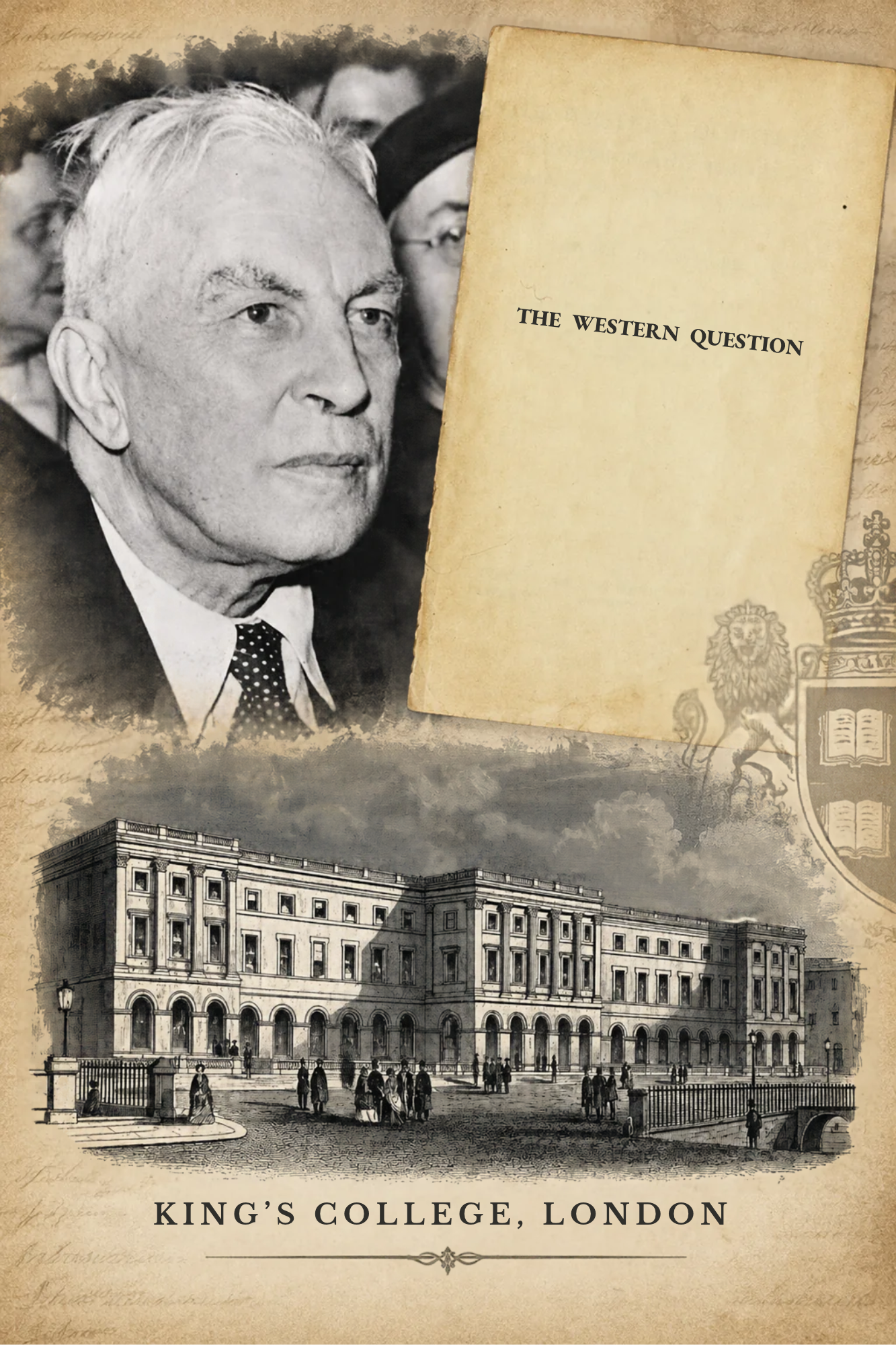
The Koraes Chair in Modern Greek and Byzantine History, Language and Literature in the King's College and Arnold Toynbee
The Koraes Chair in Modern Greek and Byzantine History, Language and Literature in King's College London was established in 1918, with the support of Eleftherios Venizelos, prime minister of Greece at the time, the Greek Parliament, and the Greek business community in London and elsewhere. The Koraes Chair was named in honor of Adamantios Koraes, an Izmir-born Greek scholar considered by Greeks to be the founding father of the modern Greek nation-state.[6] The Chair has strong financial support from the Greek Diaspora. For instance, on the eve of the centenary of the Chair in question, King's College London made the following announcement in 2017: “The re-endowment of the Koraes Chair in Modern Greek and Byzantine History, Language and Literature. Thanks to the generosity of charitable and educational foundations and individuals in Greece, Cyprus and the UK, over 1.5 million has been raised to ensure the future of this unique and prestigious Chair, which will be 100 years old next year.” [7]
During the chair’s initial establishment, it received direct financial support from a committee of wealthy Anglo-Greek merchants and business figures based in London, as well as from the Parliament of Greece. In subsequent re-endowment projects aimed at ensuring the chair’s sustainability, some of the most prominent contemporary Greek foundations have served as primary donors. In this context, the following statement of thanks from King's College provides sufficient information about the chair's donor range:
“We wish to extend heartfelt thanks to the A. G. Leventis Foundation who bravely launched this campaign, to the Stavros Niarchos Foundation for the second major gift which propelled us forward, and to the growing family of extremely generous supporters: The Hellenic College Trust, The Hellenic Foundation, The Family of Tassos and Angele Nomikos, George Vergottis Memorial Fund, Stiftung, Bank of Greece, The Schilizzi Foundation, the late Nicholas Egon FKC and Mrs Matrona Egon, Stelios Philanthropic Foundation, and the Ministry of Education and Culture of the Republic of Cyprus.”[8]
Arnold Toynbee is a prominent English historian and philosopher of history best known for his 12-volume masterwork, “A Study of History,” in which he advanced a philosophy of history grounded in an analysis of the cyclical rise and fall of civilizations. He was known as a dedicated "philhellene" during his early academic life and career, spanning roughly from 1911 to 1921. Because of his reputation as a philhellene at that time, the Greek community in London funded and appointed him as the inaugural holder of the Koraes Chair of Modern Greek and Byzantine History at King's College London in 1919,
At this point, it would be illuminating to touch on Arnold Toynbee's early works briefly, the roles he undertook at a young age, his academic writings, the evolution of his ideas and perspectives on the nature of international relations over time, and his turbulent intellectual world. Arnold Toynbee recounts the early stages of his career as follows:
“During the European War, I edited, under the direction of Lord Bryce, the Blue Book published by the British Government on the ‘Treatment of Armenians in the Ottoman Empire: 1915’. Afterward I worked, always on Turkish affairs, in the Intelligence Bureau of the Department of Information (May 1917 to May 1918); in the Political Intelligence Department of the Foreign Office (May to December 1918); and in the Foreign Office section of the British Delegation to the Peace Conference at Paris (December 1918 to April 1919).” [9]
It should be added that the so-called “Blue Book” was prepared under the direction of Irish academic, diplomat, and politician Viscount James Bryce, who was one of the prominent propagandists who helped to create a serious public opinion on the Armenian Question and hostility towards Turks, and Arnold Toynbee participated in this study as one of the young historians of the time.[10]
In fact, a turning point in Toynbee's career occurred in 1921. That year, Toynbee traveled to Anatolia as a correspondent for “The Manchester Guardian” (today's The Guardian) to report on the Greco-Turkish War. He personally witnessed the systematic massacres, forced displacements, and human rights violations committed by the Greek army and local Greek irregular bands against the Turkish civilian population in regions such as Yalova, Gemlik, and İzmit. Upon his return to England in 1922, he published his renowned work, “The Western Question In Greece And Turkey: A Study In The Contact Of Civilizations,” which detailed these observations. In the book, he criticized Greece’s Anatolian adventure, arguing that the country had acted as a tool for Western imperialism and had perpetrated grave crimes against civilians. The wealthy Anglo-Greek donors who funded the chair were left effectively shocked by this development. When they provided the funding, they had assumed that the chair would function as an instrument for Greek propaganda. And he was accused of stabbing the nation in the back. Following the publication of his cited book, Toynbee was forced to leave the Koraes Chair in 1924 for daring to write the truth.
It should also be noted that, following the Turkish War of Independence, Toynbee visited Ankara in 1923 and returned as an official guest of the Turkish Republic in 1948, developing a deep respect for Atatürk's statecraft. In this context, Prof. Dr. Hasan Köni, in his article "The Research of Arnold Toynbee on Turks and The Birth of Armenian Propaganda" published in the context of ASAM (Institute for Armenian Research) studies, states that "We will not look at Toynbee’s personality in the classic biographic method by examining his childhood, marriage and the incidents in his life, but in the field of our interest, which is more about Toynbee’s political views and his thoughts and actions on Greece and on the War of Independence of the Turks and the Greeks. “[11]
How does Toynbee portray the Greek atrocities in Anatolia in The Western Question In Greece And Turkey: A Study In The Contact Of Civilizations?
In the preface to his book, he stated that it does not aim to find a solution to the Eastern problem, but only to analyze the war in a region he knows very well from his academic studies. He stated that he traveled to the region with his wife after taking a two-year leave of absence from King's College for this study, and that he personally observed the events by visiting the war zones in Anatolia as the Manchester Guardian's special correspondent. He emphasized that he did not take sides with either the Greeks or the Turks in his analysis. Toynbee stated that anyone observing a conflict should maintain scientific objectivity within the framework of moral judgments. In this context, he stressed that he freely expressed his judgments about the truth and reality that emerged from his observations, and that if any of his judgments were in error, it should be accepted as a miscarriage of justice.
Toynbee, most probably, foresaw that the massacres and atrocities of Greece in Anatolia, which he openly expressed in his book, would be met with reaction from the Greeks and the philhellenes; he made his defense on this subject in the preface of his book. The following is an excerpt from this defense, which is important for explaining the moral pressure faced in the Western world by those who raised their voices against the massacres and atrocities committed by Greece:
“It may, I fear, be painful to Greeks and ‘Philhellenes’ that information and reflections unfavorable to Greece should have been published by the first occupant of the Koraís Chair. I naturally regret this, but from the academic point of view it is less unfortunate than if my conclusions on the Anatolian Question had been favorable to Greece and unfavorable to Turkey. The actual circumstances, whatever personal unpleasantness they may entail for me and my Greek friends and acquaintances, at least preclude the suspicion that an endowment of learning in a British University has been used for propaganda on behalf of the country with which it is concerned. Such a contention, if it could be urged, would be serious; for academic study should have no political purpose, although, when its subject is history, its judgments upon the nature and causal connection of past events do occasionally and incidentally have some effect upon the present and the future.”[12]
Following his contentious resignation from the Koraes Chair in 1924, Arnold J. Toynbee did not harbor any personal animosity toward Greece or Greek culture; on the contrary, he maintained his academic and intellectual connection to Hellenism. In his view, Greece was no longer merely an innocent victim or the sole sacred cradle of Western civilization, but rather had become an ordinary Eastern European state afflicted by the malady of nationalism and reduced to a pawn of global powers.
Conclusion
Arnold Toynbee’s “The Western Question in Greece and Turkey: A Study in the Contact of Civilizations” is generally considered a foundational work in world history and international relations. His assertive assesments in his work like the “ contact of civilisations has always been, and will always continue to be, a ruling factor in human progress and failure”, “the masterful influence of Western form of society upon people of other civilisations” or “Western factor in the Near and Middle East on the whole an anarchic and destructive force, and at the same time it appears to be almost the only positive force in the field” inevitably evoke more contemporary concepts like clash of civilazations, Eurocentrism, Western-centrism, Western superiority, Orientalism, imperialism, and bring to the fore the discussions of East -West dichotomy. He examines the dual nature of the West—viewed as an oxymoron —and portrays the Western factor in the Near and Middle East as both an "anarchic and destructive force" and "the only positive force in the field." He reconceptualizes the "Eastern Question" as the "Western Question" and argues that the core issue is actually a "Western Question." It is fair to say that such intelligent observations Toynbee made at the time elevated the book in question to the status of a “seminal work” on the international stage.
On the other hand, Toynbee’s work is also highly regarded for its subversion of traditional Eurocentric perspectives and its rigorous eyewitness documentation of human rights abuses during 1919-1922. This eyewitness documentation is indeed uniquely notable for its unsparing, detailed coverage of the atrocities committed by the Greek Army and local Greek Christian paramilitaries against the Turkish Muslim population during the Turkish War of Independence. Unlike many Western figures of the era who relied on second-hand reports shaped by a mostly colonial mindset, Toynbee conducted first-hand field research in the regions of İzmit, Yalova, and Gemlik in 1921.[13] He personally participated in Red Cross rescue missions for Turkish civilians fleeing systemic violence. It should be mentioned at this point without going into the details that to investigate the atrocities committed in the Gemlik, Yalova and Izmit regions the Allied Powers had to establish in 1921 another Inter-Allied Commission of inquiry in mid-April of the same year to conduct enquiries regarding the “excesses committed against the Turkish population” and Maurice Gehri, the representative of the Geneva International Red Cross accompanied the Inter-Allied Commission expressed his view regarding the “the extermination of the Moslem population of the Yalova-Gemlik peninsula” in his article published in the Bulletin of Red Cross in 1921. It can be said that these sections of Toynbee’s book, especially Chapter VII sub-titled “The War of Extermination,” which details the massacres carried out by Greece in Anatolia, bring to light the obscured silent truth of atrocities committed by Greece against the Turkish population in Anatolia.
As we noted in our AVIM analysis titled "Historical Memory, Legal Precisıon, and Selective Narratives: Greece’s 14 September Declaration," when a historical tragedy is presented through an exclusive and legally ambiguous one-sided narrative of victimhood, it risks fostering hostile perceptions, marginalizing the documented suffering of other civilian communities, and diluting the meaning of legal concepts related to persecution. Academics and educators have an ethical responsibility to preserve memory and prevent the distortion of history. This responsibility necessitates that contemporary studies concerning that period also address international evidence regarding the brutal acts of violence committed against Turkish and Muslim civilians during Greece’s attempt to occupy Turkish territory. In this context, particularly within academic research and public discourse, it is essential to acknowledge the suffering experienced by all civilian communities without transforming historical memory into a contemporary source of new hostility. Historical memory deserves respect only when it is comprehensive, evidence-based, and legally precise. Disregarding the documented violence against Turkish and Muslim civilians during the Greek attempt to occupy Anatolia is incompatible with the principle that history should neither be erased nor effaced or falsified. Such an intentional selective approach is inconsistent with academic ethics.
*Picture: Wikimedia, Wikimedia and Archive.org
[1] Teoman Ertuğrul Tulun, “Greece: 1821 Celebrations, Tripolitsa Massacre, BBC and Fake News,” AVİM Analysis No. 2021/12, 31 March 2021, https://avim.org.tr/en/Analiz/GREECE-1821-CELEBRATIONS-TRIPOLITSA-MASSACRE-BBC-AND-FAKE-NEWS ; Teoman Ertuğrul Tulun. Trıpolıtsa: Selectıve Memory And The Destructıon Of The Muslım Turkısh Morea. AVİM Commentary No : 2026 / 55,24.09.2026. https://avimbulten.org/en/Yorum/TRIPOLITSA-SELECTIVE-MEMORY-AND-THE-DESTRUCTION-OF-THE-MUSLIM-TURKISH-MOREA
[2] St Clair, William. That Greece Might Still Be Free: The Philhellenes in the War of Independence. 1st ed. Open Book Publishers, 2008, p. xvıı- xvııı. https://doi.org/10.2307/j.ctt5vjt7w.
[3] Finlay, George. 1861. History of the Greek Revolution. Edinburgh: Wiliam Blackwood and Sons. Edinburgh and London, p, 187-188
[4][4] Phillips, W. Alison. 1897. The War of Greek Independence, 1821 to 1833. New York: C. Scribner’s Sons, p 48.
[5] Phillips, W. Alison. 1897. The War of Greek Independence, 1821 to 1833. New York: C. Scribner’s Sons, p 48.
[6] Tulun, Teoman Ertuğrul. “The Silent Truth: Greece’s Atrocities and Crimes Against Turkish Population” in Yunanistan Tarafından Anadolu’da İşlenen İnsanlik Suçları: İşgalci Mağdur Olabilir mi? 17 Mayıs 2022 Sempozyum Bildiriler Kitabı. Türk Tarih Kurumu Ankara 2024. e-ISBN 978-975-17-5924-5
DOI: 10.37879/9789751759245.2024
[7][7] King’s College London News Center. Announcing the re-endowment of the Koraes Chair. 17 October 2017. https://www.kcl.ac.uk/news/announcing-the-re-endowment-of-the-koraes-chair-2
[8] King’s College London News Center. Announcing the re-endowment of the Koraes Chair. 17 October 2017. https://www.kcl.ac.uk/news/announcing-the-re-endowment-of-the-koraes-chair-2
[9] Arnold J. Toynbee, (1922) The Western Question in Greece and Turkey: A Study in the Contact of Civilisations. London: Constable and Company Ltd., 1922, p. viii-ıx.
[10] Fahriye Begüm Yıldızeli . “James Bryce’in Ermeni Sorunu’ndaki Rolü.” Tarih Dergisi - Turkish Journal
of History, 83 (2024): 168-191, p. 183. https://doi.org/10.26650/iutd.20241450659
[11] Hasan Köni. The Research of Arnold Toynbee on Turks and The Birth of Armenian Propaganda. (ASAM
Institute for Armenian Research.) Armenian Studies, Number Issue 2, June-July-August 2001, https://www.eraren.org/index.php?Lisan=en&Page=Print&DergiIcerikNo=226&Yer=DergiIcerik
[12] Arnold J. Toynbee, (1922) The Western Question in Greece and Turkey: A Study in the Contact of Civilisations. London: Constable and Company Ltd., 1922, p. X-XI
[13] Gehri, Maurice. (1921). Mission d'Enquete en Anatolie, 12-22 Mai 1921. Revue Internationale. De La Croix-Rouge. Bulletin International Des Sociétés De La Croix-Rouge. 3 Année, No. 31, 15 Juillet 1921, pp. 722- 735. (Geneva, 1921.)
© 2009-2025 Center for Eurasian Studies (AVİM) All Rights Reserved
No comments yet.
-
 GREEK FOREIGN MINISTER DENDIAS CONCEDES THE DEMILITARIZED STATUS OF THE EASTERN AEGEAN ISLANDS AND THE DODECANESE
Teoman Ertuğrul TULUN 14.03.2022 -
 CENTURY OLD “WHITE SUPREMACISM” AND THE FAR-RIGHT’S RISE IN SWEDEN: A CREDIBLE CHALLENGE TO PROGRESSIVE VALUES AND POLICIES?
Teoman Ertuğrul TULUN 25.01.2018 -
 CONSEQUENCES OF MATERIAL BREACH OF THE LAUSANNE PEACE TREATY
Teoman Ertuğrul TULUN 07.10.2020 -
 GREECE: 1821 CELEBRATIONS, TRIPOLITSA MASSACRE, BBC AND FAKE NEWS
Teoman Ertuğrul TULUN 31.03.2021 -
 SOUL-SEARCHING IN SOUTHEAST ASIA: EMERGING RIFTS BETWEEN OLD FRIENDS AND NEW FOREIGN POLICY DIRECTIONS
Teoman Ertuğrul TULUN 17.01.2017
-
 A QUARTER OF A CENTURY OF INDEPENDENCE OF CENTRAL ASIAN AND SOUTH CAUCASUS COUNTRIES: AN ECONOMIC SNAPSHOT AND PROSPECTS FOR THE FUTURE
Teoman Ertuğrul TULUN 14.12.2016 -
 OVERLAPPING INTERESTS IN THE SOUTH CAUCASUS: THE AZERBAIJAN, ISRAEL AND IRAN TRIANGLE
İlaha KHANTAMİROVA 29.05.2025 -
 EUROPEAN PARLIAMENT’S UNCONSTRUCTIVE APPROACH TOWARDS TURKEY
Teoman Ertuğrul TULUN 20.03.2019 -
 ANZAC DAY: “THERE IS NO DIFFERENCE BETWEEN THE JOHNNIES AND THE MEHMETS TO US WHERE THEY LIE SIDE BY SIDE” AT GALLIPOLI. IS THIS THE CASE FOR OTHER COUNTRIES?
Teoman Ertuğrul TULUN 30.04.2019 -
 ARMENIA, THE 'BRANCH OF RUSSIA' IN THE SOUTH CAUCASUS
Maxime GAUIN 31.08.2015
-
25.01.2016
THE ARMENIAN QUESTION - BASIC KNOWLEDGE AND DOCUMENTATION -
12.06.2024
THE TRUTH WILL OUT -
27.03.2023
RADİKAL ERMENİ UNSURLARCA GERÇEKLEŞTİRİLEN MEZALİMLER VE VANDALİZM -
17.03.2023
PATRIOTISM PERVERTED -
23.02.2023
MEN ARE LIKE THAT -
03.02.2023
BAKÜ-TİFLİS-CEYHAN BORU HATTININ YAŞANAN TARİHİ -
16.12.2022
INTERNATIONAL SCHOLARS ON THE EVENTS OF 1915 -
07.12.2022
FAKE PHOTOS AND THE ARMENIAN PROPAGANDA -
07.12.2022
ERMENİ PROPAGANDASI VE SAHTE RESİMLER -
01.01.2022
A Letter From Japan - Strategically Mum: The Silence of the Armenians -
01.01.2022
Japonya'dan Bir Mektup - Stratejik Suskunluk: Ermenilerin Sessizliği -
03.06.2020
Anastas Mikoyan: Confessions of an Armenian Bolshevik -
08.04.2020
Sovyet Sonrası Ukrayna’da Devlet, Toplum ve Siyaset - Değişen Dinamikler, Dönüşen Kimlikler -
12.06.2018
Ermeni Sorunuyla İlgili İngiliz Belgeleri (1912-1923) - British Documents on Armenian Question (1912-1923) -
02.12.2016
Turkish-Russian Academics: A Historical Study on the Caucasus -
01.07.2016
Gürcistan'daki Müslüman Topluluklar: Azınlık Hakları, Kimlik, Siyaset -
10.03.2016
Armenian Diaspora: Diaspora, State and the Imagination of the Republic of Armenia -
24.01.2016
ERMENİ SORUNU - TEMEL BİLGİ VE BELGELER (2. BASKI)
-
AVİM Conference Hall 24.01.2023
CONFERENCE TITLED “HUNGARY’S PERSPECTIVES ON THE TURKIC WORLD"