














In our commentary on the report titled "Under Destruction," prepared for the 62nd Munich Security Conference held between February 13-15, 2026, it was stated that the report primarily addresses the theme that the international order, which is claimed to be based on the rules established after World War II, is under destruction, and that the main responsibility for this destruction lies with US President Trump and his supporters. The report also highlighted the view that the US, instead of protecting this order and pursuing corrective policies against forces opposing it, is now itself focused on destroying the order.[1]
When the speeches and opinions expressed at the Conference are evaluated as a whole, it can be said that the Conference was shaped by conflicting narratives about the current state of the rules-based international order. Per some narratives, the order is damaged or completely broken, while according to others, although it is damaged to a certain extent, possibilities for reconstruction on its old foundations exist and a period of work on this is underway. According to those who put forward this view, especially on the European continent, there is a possibility of creating defense lines to protect and preserve valuable values and rules, filling at least some of the gaps in global governance, and forming new coalitions without allowing the complete collapse of the Atlantic-European axis and without breaking away from the US.
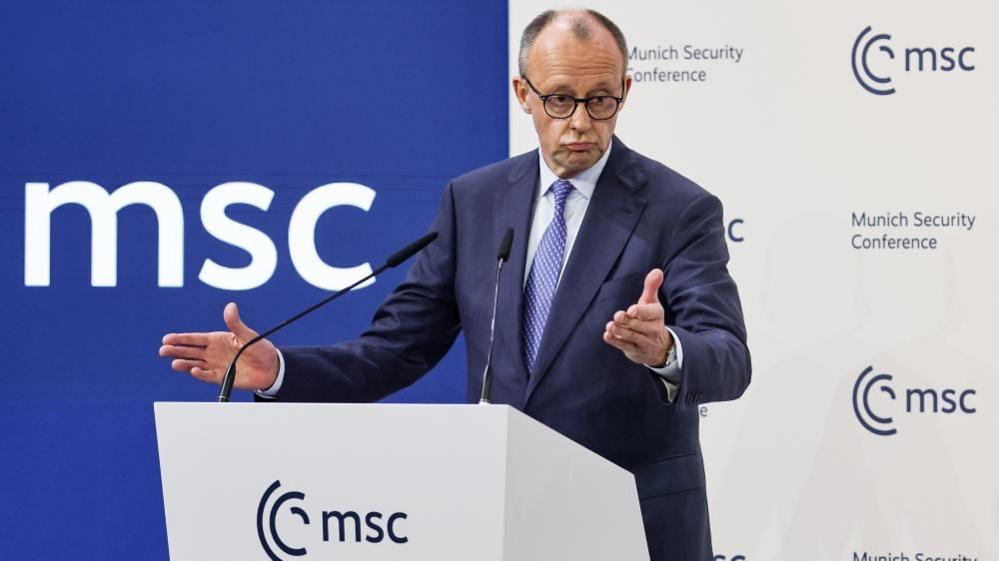
We can say that the most comprehensive, frank, and courageous view of the current international order was expressed by German Chancellor Friedrich Merz in his opening address to the Conference. Merz critically interpreted the Conference report's title, "Under Destruction" as follows”
“This conference has a sombre title: Under Destruction. This title appears to suggest that the international order, which was based on rights and rules, is in the process of being destroyed. ‑ I fear we must put this even more bluntly: this order, as imperfect as it was even at the best of times, no longer exists.”[2]
One of the most noteworthy aspects of Prime Minister Merz's speech from Türkiye's perspective is the section where he outlines his views on what Europe should do to ensure its security and freedom in the coming period. While the conference report strongly emphasizes the need for Europe to cooperate, particularly with the Indo-Pacific region, and dedicates a separate section to this need, Türkiye is not mentioned even once. In contrast, Prime Minister Merz expressed the following noteworthy view regarding Türkiye in his speech:
“No matter how important European integration and the transatlantic partnership will remain for us, they will no longer be enough to preserve our freedom. Partnership is not an absolute term here. A partnership does not require total agreement on all values and interests. That is one of the lessons of these days, weeks and months. We are growing closer to new partners, with whom we do not share all concerns, but with whom we have important concerns in common. This prevents dependencies and risks, while also opening up options and opportunities for both sides. It protects our freedom. Canada, Japan, Türkiye, India, Brazil, as well as South Africa, the Gulf states and other countries will play a key role here. We want to have closer relations with these countries in a spirit of mutual respect and with a view to the long term.”
In what was undoubtedly the most anticipated speech of the conference, US Secretary of State Marco Rubio adopted a different tone than that of Vice President J.V. Vance, whose harsh, even crude, criticisms of European countries at last year's Munich Security Conference had caused a cooling in transatlantic relations. Rubio presented US criticism of Europe in a mild and amicable way like "bitter criticism coated in sugar" fashion.
In his speech, the US Secretary of State emphasized that America and Europe share common roots and a common destiny, but that the economic and cultural decline must be reversed, and that Europe must work with Washington in its quest for civilization to save the West. In this context, it is possible to say that one of the most striking aspects of Rubion's speech was his comprehensive assessment that Christianity constitutes the essence of Western civilization. Short excerpts from Rubion's points in this regard are presented below:
“For the United States and Europe, we belong together. America was founded 250 years ago, but the roots began here on this continent long before. The man who settled and built the nation of my birth arrived on our shores carrying the memories and the traditions and the Christian faith of their ancestors as a sacred inheritance, an unbreakable link between the old world and the new. We are part of one civilization – Western civilization. We are bound to one another by the deepest bonds that nations could share, forged by centuries of shared history, Christian faith, culture, heritage, language, ancestry, and the sacrifices our forefathers made together for the common civilization to which we have fallen heir. And so this is why we Americans may sometimes come off as a little direct and urgent in our counsel. This is why President Trump demands seriousness and reciprocity from our friends here in Europe. The reason why, my friends, is because we care deeply. We care deeply about your future and ours. And if at times we disagree, our disagreements come from our profound sense of concern about a Europe with which we are connected – not just economically, not just militarily. We are connected spiritually and we are connected culturally. We want Europe to be strong. We believe that Europe must survive, because the two great wars of the last century serve for us as history’s constant reminder that ultimately, our destiny is and will always be intertwined with yours, because we know that the fate of Europe will never be irrelevant to our own… And this is why we do not want our allies to be weak, because that makes us weaker. We want allies who can defend themselves so that no adversary will ever be tempted to test our collective strength. This is why we do not want our allies to be shackled by guilt and shame. We want allies who are proud of their culture and of their heritage, who understand that we are heirs to the same great and noble civilization, and who, together with us, are willing and able to defend it.”[3]
In addition to stating these points, the US Secretary of State also made it quite clear that they wanted their allies to confront what was needed to correct the broken status quo, not to rationalize it; that they did not wish to remain the polite and orderly caretaker of the West's decline; and that they believed the greatest civilization in human history needed to be renewed. He stated that the alliance they desired was one not paralyzed by fears such as climate change, war, or technology, but one that boldly moved forward into the future. In short, Rubio presented the US demands from Europe, the EU, and the NATO Alliance without mincing words, but in a way that was as non-offensive as possible, and also touched upon points that would flatter European pride.
In his speech, British Prime Minister Keir Starmer, one of the other leading speakers, particularly highlighted the situation in Ukraine and Russia's threat to Europe, emphasizing the need for unified action against Russia. Prime Minister Starmer approached the discourse of the collapse of the international order cautiously, stating that "there can be no British security without Europe, and no European security without Britain," that the US remains an indispensable force for European security, and that the US National Security Strategy's clear statement that Europe should be primarily responsible for its own defense represents a new understanding. He agreed that the world has fundamentally changed and that new ways must be found to protect shared values and the rule of law, but stressed that in addressing this need, the elements that have sustained the West for the past 80 years cannot be ignored. The British Prime Minister stated that this situation could be considered "a moment of collapse," but that this moment should be seen "not as a moment of rupture, but as a moment of radical renewal.”
A significant point that stood out in Keir Starmer's speech was his statements regarding nuclear power. In this context, Starmer stated the following:
“We are enhancing our nuclear cooperation with France. For decades the UK has been the only nuclear power in Europe to commit its deterrent to protect all NATO members. But now any adversary must know that in a crisis they could be confronted by our combined strength.”[4]
The British Prime Minister also stated that they wanted to accelerate defense production by bringing together their leadership in defense, technology and artificial intelligence with Europe, creating a common industrial base across the continent, and that they had done this with Germany and France at E3, adding that they were “working closely with Italy and Poland in particular, as well as Norway, Canada and Türkiye.”
French President Emmanuel Macron also addressed the issue of nuclear power cooperation in his speech at the Conference, stating that they need to redefine nuclear deterrence and that they have initiated a strategic dialogue on this matter, which he will detail in a few weeks. In response to a question during the Q&A session that followed his speech, Macron said, “I would also like to point out that we have a special dialogue with the United Kingdom, which is a nuclear power, and a few months ago in Northwood we concluded a new agreement outlining progress in this cooperation… We also have a very special discussion with Sweden [on this matter], but with a selective approach.”[5]
In her speech at the conference, European Commission President Ursula von der Leyen, as expected, emphasized the need for the European Union, which she described as Europe from her perspective, to be an independent power. The Commission President stated that an independent Europe, which she assumed consisted only of the EU, would be a strong Europe, that a strong Europe would lead to a stronger transatlantic alliance, that it was necessary to focus on Europe's independence plan, that European security should always be seen as a primary responsibility, that Europe needed to act and assume its responsibility, that a new European Security Strategy was needed in this context, that the way all policy tools are used to create this strategy needed to be urgently reviewed, and that she believed it was time for Europe to implement the "mutual defense clause." She stated that mutual defense was not optional for the EU, but an obligation under Article 44(7) of the EU Treaty.[6]
Final Remarks
When the speeches and discussions that shaped the conference are evaluated as a whole, it seems possible to say that the order established by the Western world under the leadership of the USA after the Second World War, which European powers and primarily the European Union tried to impose on the whole world as a "rules-based international order" based on their own priorities, and which is essentially distorted due to its significant double standards, has been fundamentally shaken and is entering a serious process of collapse due to the criticisms of the current US administration and its withdrawal of support for this order for the moment.
Merz's speech points to a paradoxical approach when compared to Germany's long-standing advocacy for the indispensability of liberal democratic values; while he emphasizes freedom and the rule of law in rhetoric, in practice he significantly deviates from Germany's traditional liberal-normative line by emphasizing power politics, military capacity, and geostrategic autonomy.
Current developments indicate that the international order has entered a "period of interregnum." In other words, the door has been opened to a new era of global disorder. During this period, the EU, institutionally defining itself as Europe, is attempting to act as the sole representative of the continent, adopting an attitude that could exclude other European countries, and tending to cooperate only with its former member, the UK, outside of EU member states. On the other hand, it is noteworthy that a group within the EU, likely led by Germany, and the UK are signaling their willingness to explore the possibility of forming new coalitions and formats that could bring together those who are eager to strengthen and reshape efforts to solve global problems within the context of establishing a new international order. Therefore, it is considered wise to approach this view, which sees Turkey as being among the group of countries outside Europe with which cooperation is possible, with great caution. It is also prudent to evaluate this approach as a "sugar-coated" indirect exclusion from Europe, and to continue pursuing policies that will strengthen Türkiye's "strategic autonomy" during the probable "interregnum period" in the international world order.
*Picture: BBC
[1] Teoman Ertuğrul Tulun. The Myth Of Rules-Based International Order Is Under Destruction Commentary No: 2026 / 10. 13.02.2026. https://avim.org.tr/en/Yorum/THE-MYTH-OF-RULES-BASED-INTERNATIONAL-ORDER-IS-UNDER-DESTRUCTION
[2] SPEECH BY FEDERAL CHANCELLOR MERZ AT THE MUNİCH SECURİTY CONFERENCE 2026 https://www.bundesregierung.de/breg-en/federal-government/speech-chancellor-msc-2407256
[3] SECRETARY OF STATE MARCO RUBİO AT THE MUNİCH SECURİTY CONFERENCE REMARKS (https://www.state.gov/releases/office-of-the-spokesperson/2026/02/secretary-of-state-marco-rubio-at-the-munich-security-conference/
[4] PM speech during the Munich Security Conference: 14 February 2026. Prime Minister Keir Starmer gave a speech during the Munich Security Conference https://www.gov.uk/government/speeches/pm-speech-during-the-munich-security-conference-14-february
[5] 13 février 2026 - Seul le prononcé fait foi Discours du Président de la République lors de la 62e Conférence de Munich sur la Sécurité. https://www.elysee.fr/emmanuel-macron/2026/02/13/conference-de-munich-sur-la-securite-en-allemagne
[6] Speech by President von der Leyen at the Munich Security Conference 2026. Speech by the President at the Munich Security Conference 2026
© 2009-2025 Center for Eurasian Studies (AVİM) All Rights Reserved
No comments yet.
-
 POSSIBLE EFFECTS OF A RUSSIAN-CHINESE JOINT SWIFT SYSTEM ON THE EURASIAN ECONOMY AND THE WORLD TRADE SYSTEM
Teoman Ertuğrul TULUN 23.12.2021 -
 CONCERTED EFFORTS TO DOWNPLAY THE MILESTONES OF THE REPUBLIC OF TÜRKİYE AND TURKISH HISTORY
Teoman Ertuğrul TULUN 14.06.2023 -
 THE ORTHODOX CHURCH : ECCLESIASTICAL BATTLE OF MONTENEGRINS WITH THE SERBIAN ORTHODOX CHURCH
Teoman Ertuğrul TULUN 01.09.2022 -
 EU'S FAILURE TO FULFILL ITS HUMAN RIGHTS RESPONSIBILITIES: STATEMENT BY THE EU SPECIAL REPRESENTATIVE FOR HUMAN RIGHTS AT THE UN
Teoman Ertuğrul TULUN 18.10.2022 -
 CENTURY OLD “WHITE SUPREMACISM” AND THE FAR-RIGHT’S RISE IN SWEDEN: A CREDIBLE CHALLENGE TO PROGRESSIVE VALUES AND POLICIES?
Teoman Ertuğrul TULUN 25.01.2018
-
 AN ANALYSIS OF THE POLITICS IN ARMENIA AFTER THE “VELVET REVOLUTION”
Turgut Kerem TUNCEL 01.06.2018 -
 A QUARTER OF A CENTURY OF INDEPENDENCE OF CENTRAL ASIAN AND SOUTH CAUCASUS COUNTRIES: AN ECONOMIC SNAPSHOT AND PROSPECTS FOR THE FUTURE
Teoman Ertuğrul TULUN 14.12.2016 -
 SOUTH-EAST EUROPEAN COOPERATION PROCESS AND TÜRKİYE’S BALKAN IDENTITY
Teoman Ertuğrul TULUN 19.06.2026 -
 THE DURABILITY OF SILK IN MOUNTAINS OF CAUCASUS: CHINA AND ARMENIA
Teoman Ertuğrul TULUN 13.09.2017 -
 PARTS OF A BROKEN PUZZLE: GERMANY, BREXIT, TRUMP AND TURKEY
Teoman Ertuğrul TULUN 01.06.2017
-
25.01.2016
THE ARMENIAN QUESTION - BASIC KNOWLEDGE AND DOCUMENTATION -
12.06.2024
THE TRUTH WILL OUT -
27.03.2023
RADİKAL ERMENİ UNSURLARCA GERÇEKLEŞTİRİLEN MEZALİMLER VE VANDALİZM -
17.03.2023
PATRIOTISM PERVERTED -
23.02.2023
MEN ARE LIKE THAT -
03.02.2023
BAKÜ-TİFLİS-CEYHAN BORU HATTININ YAŞANAN TARİHİ -
16.12.2022
INTERNATIONAL SCHOLARS ON THE EVENTS OF 1915 -
07.12.2022
FAKE PHOTOS AND THE ARMENIAN PROPAGANDA -
07.12.2022
ERMENİ PROPAGANDASI VE SAHTE RESİMLER -
01.01.2022
A Letter From Japan - Strategically Mum: The Silence of the Armenians -
01.01.2022
Japonya'dan Bir Mektup - Stratejik Suskunluk: Ermenilerin Sessizliği -
03.06.2020
Anastas Mikoyan: Confessions of an Armenian Bolshevik -
08.04.2020
Sovyet Sonrası Ukrayna’da Devlet, Toplum ve Siyaset - Değişen Dinamikler, Dönüşen Kimlikler -
12.06.2018
Ermeni Sorunuyla İlgili İngiliz Belgeleri (1912-1923) - British Documents on Armenian Question (1912-1923) -
02.12.2016
Turkish-Russian Academics: A Historical Study on the Caucasus -
01.07.2016
Gürcistan'daki Müslüman Topluluklar: Azınlık Hakları, Kimlik, Siyaset -
10.03.2016
Armenian Diaspora: Diaspora, State and the Imagination of the Republic of Armenia -
24.01.2016
ERMENİ SORUNU - TEMEL BİLGİ VE BELGELER (2. BASKI)
-
AVİM Conference Hall 24.01.2023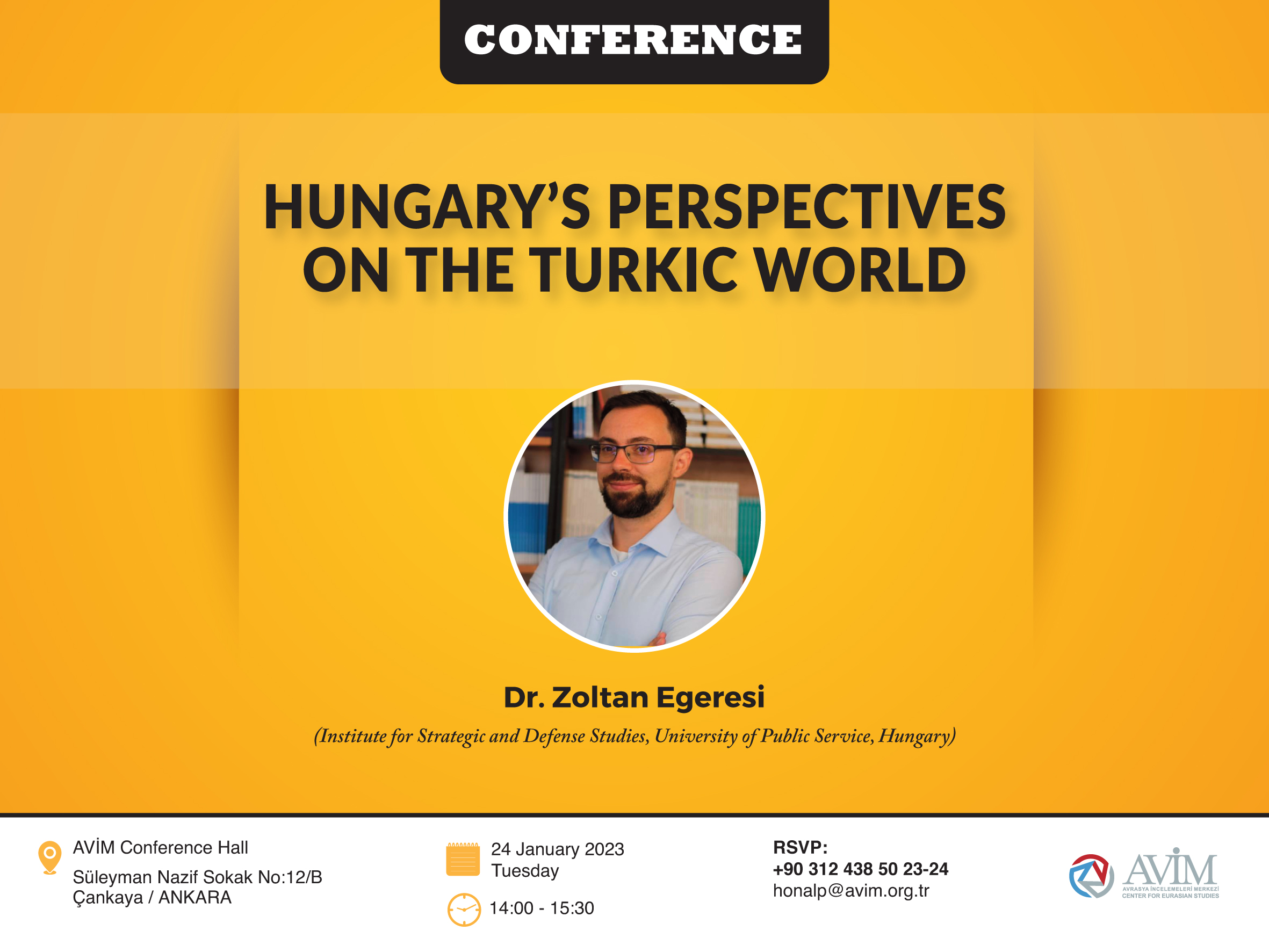
CONFERENCE TITLED “HUNGARY’S PERSPECTIVES ON THE TURKIC WORLD"