














Kazakhstan: Founding Member of the Organization of Turkic States
The forerunner of the Organization of Turkic States (OTS), the Turkic Council (TC), was founded on October 3, 2009, to promote comprehensive cooperation among the Turkic States. The Republic of Kazakhstan is among the founding members of TC and the OTS, which has since become a beacon of value for the Turkic world. In fact, the founder and first President of the Republic of Kazakhstan, Nursultan Nazarbayev, a visionary statesman, supported the idea of the Turkic Council wholeheartedly and helped bring it to the international stage, establishing it as a full-fledged international organization with headquarters in İstanbul.[1]
Kazakhstan’s Accession to the Abraham Accords
The Kazakh Foreign Affairs Ministry officially declared on November 7, 2025, that Kazakhstan had acceded to the Abraham Accords, US-sponsored agreements aimed at normalizing relations between Israel and several Muslim-majority countries. The Ministry’s statement announced that “This important decision was made solely in the interests of Kazakhstan and is fully consistent with the nature of the republic’s balanced, constructive, and peaceful foreign policy. strategic goals."[2] In the meantime, per the The Astana Times, Kazakhastan’s President Kassym-Jomart Tokayev stated that “by joining the Abraham Accords, Kazakhstan aims ‘to help overcome confrontation, promote dialogue, and support international law grounded in the UN Charter’ [and] also underlined that this move ‘does not affect Kazakhstan’s bilateral commitments with any state,’ reflecting the country’s multilateral and peace-oriented diplomacy.”[3]
Netanyahu's rhetoric about a 'hexagon' of alliances around or within the Middle East
Before Indian Prime Minister Modi's "state visit" to Israel on February 25-26, Israeli Prime Minister Netanyahu made statements regarding the balance of power in the Middle East before the cabinet meeting on February 22, which is of interest to Türkiye. Netanyahu's remarks regarding this matter are quoted verbatim in the Israeli Foreign Ministry statement as follows:
“This week, expression will be given to the special relationship that has been forged over recent years between Israel and the global power that is India, and between me and its leader, Prime Minister Modi... In any case, one thing has happened: The fabric of this relationship has grown tighter, and he is coming here so we can tighten it further through a series of decisions related to strengthening cooperation between our governments and countries.
I want to say something regarding the diplomatic aspect: In the vision I see before me, we will create an entire system, essentially a 'hexagon' of alliances around or within the Middle East. This includes India, Arab nations, African nations, Mediterranean nations (Greece and Cyprus), and nations in Asia that I won't detail at the moment. I will present this in an organized manner.”[4]
Netanyahu also stated that the aim is to "create an axis of nations that share the same views on reality, challenges and goals, against both the radical Shiite axis, which they have dealt very hard blows to, and the emerging radical Sunni axis.”
In this context, although he is avoiding naming them at this stage, there are assessments and predictions being made about which Asian countries Netanyahu is aiming to cooperate with. For example, a news commentary piece recently published in one of the leading Turkish newspapers noted that it is clear that Türkiye is the target of Israel's recent developments in relations with Greece and the Greek Cypriot administration, and stated that "it is possible that the Asian country Netanyahu referred to without naming it is Kazakhstan."[5] Meanwhile, it is worth remembering that Kazakhstan was the first member of the OTS to announce its decision to appoint an ambassador to the Greek Cypriot Administration last year.
Final Remarks
Given the current turmoil in international relations, the serious debates surrounding whether the so-called rules-based international order is collapsing and the paradigm shifts in development and foreign policy orientations, it is necessary to assess developments in Türkiye's vicinity realistically, rather than emotionally. Information from open sources indicates that Kazakhstan, which has relations with Türkiye that go beyond kinship, has for some time been pursuing its traditional, multifaceted diplomacy, adverse to the sensitivities of Turkish public opinion. There is no doubt that multifaceted diplomacy has its delicate lines. In this type of diplomacy, it is sometimes difficult to predict what seemingly insignificant adjustments may evolve into. It is not unlikely that such adjustments may suddenly lead to highly unsettling consequences. Thus, identifying connections and implications among events, and diagnosing and naming new formations, even in their nascent stages, requires diplomatic finesse.
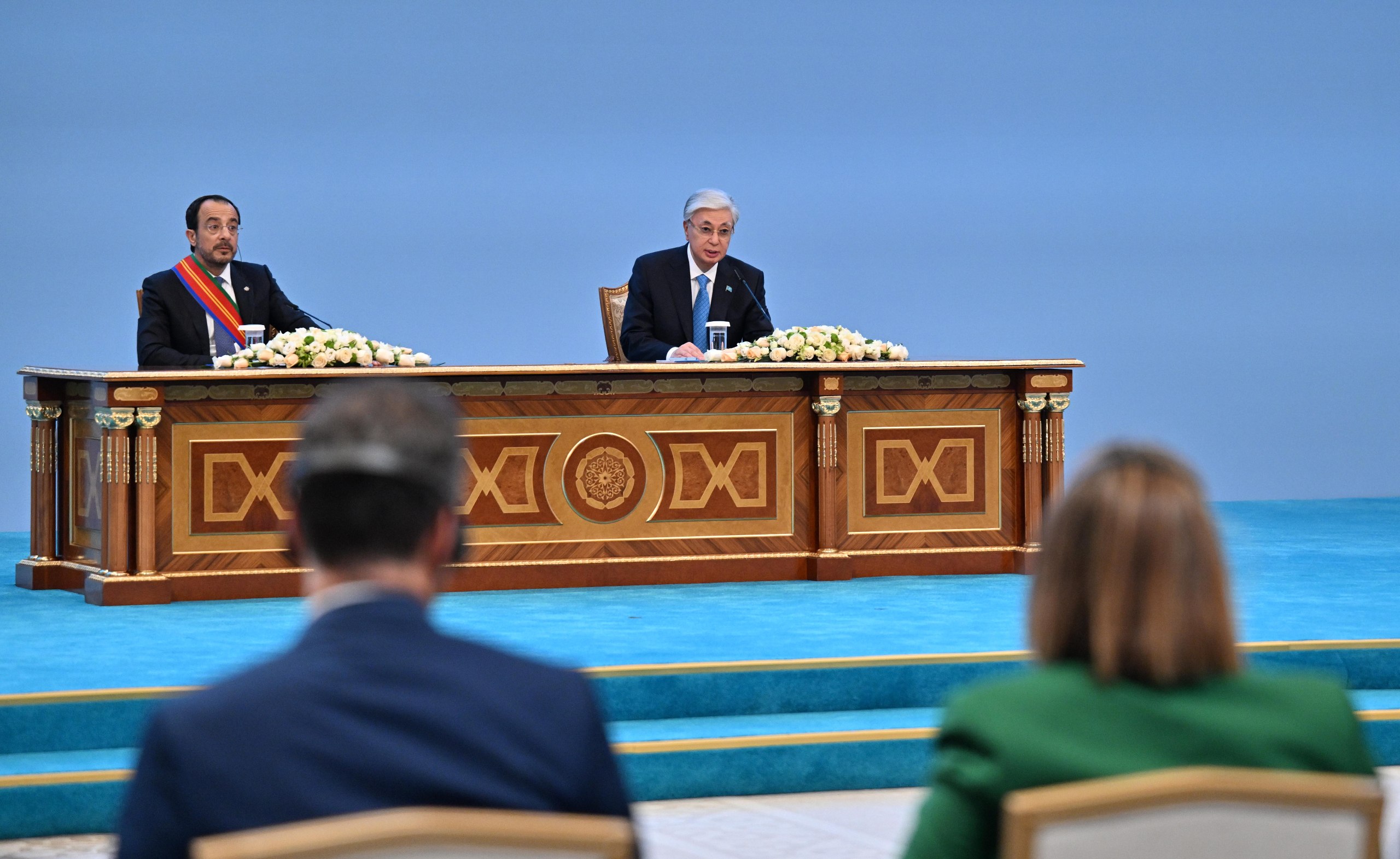
In this regard, the recent statements by President Tokayev praising the Greek Cypriot leader and the accelerating openings towards the Greek Cypriot Administration must be seen as part of a broader pattern in which certain external actors, foremost the EU and some of its member states, seek to instrumentalize political and strategic differences among Turkic states in order to dilute the cohesion of the Turkic world.[6] While Brussels continues to speak the language of a so‑called rules‑based order, its selective sensitivity to issues directly affecting Türkiye and the Turkish world reveals a clear double standard that encourages policies that run counter to genuine regional ownership. Against this backdrop, the institutional consolidation and further strengthening of the Organization of Turkic States acquire even greater importance, not only as a framework for functional cooperation but also as a political platform capable of resisting divisive external agendas.
Kazakhstan, which played a pioneering role in this process during the Nazarbayev period, bears a particular responsibility to ensure that its multi‑vector diplomacy does not, even unintentionally, undermine this emerging solidarity and cohesion within the Turkic world.
*Picture: The Times of Central Asia
[1] Teoman Ertuğrul Tulun. The Republic Of Kazakhstan: Initiator Of The Organization Of Turkic States Commentary No : 2022 / 2. 06.01.2022. doi: 10.31219/osf.io/94kda . https://avim.org.tr/en/Yorum/THE-REPUBLIC-OF-KAZAKHSTAN-INITIATOR-OF-THE-ORGANIZATION-OF-TURKIC-STATES
[2] Gov.kz. Statement of the Ministry of Foreign Affairs of the Republic of Kazakhstan on the Accession to the Abraham Accords https://www.gov.kz/memleket/entities/mfa/press/news/details/1101139?lang=en
[3] The Astana Times. Kazakh MFA Confirms Kazakhstan’s Accession to Abraham Accords After Trump–Tokayev Talks. 7November 2025. https://astanatimes.com/2025/11/kazakh-mfa-confirms-kazakhstans-accession-to-abraham-accords-after-trump-tokayev-talks/
[4] Israel Ministry of Foreign Affairs. PM Netanyahu’s remarks at the start of today’s Government meeting. 22.02.2026. https://www.gov.il/en/pages/pm-netanyahu-s-remarks-at-the-start-of-today-s-government-meeting-22-feb-2026
[5] Gökçe Aytulu, Hürriyet. Altıgen İttifak’ın hedefi Türkiye mi? 25 Şuubat 2026 https://www.hurriyet.com.tr/yazarlar/gokce-aytulu/altigen-ittifakin-hedefi-turkiye-mi-43115745
[6] Meryem Üstün, Haber 7. Kazak Cumhurbaşkanından Rum lidere övgü dolu sözler: Sizi takdir ediyorum 03 Haziran 2026 https://www.haber7.com/dunya/haber/3632766-kazak-cumhurbaskanindan-rum-lidere-ovgu-dolu-sozler-sizi-takdir-ediyorum
© 2009-2025 Center for Eurasian Studies (AVİM) All Rights Reserved
No comments yet.
-
 A QUARTER OF A CENTURY OF INDEPENDENCE OF CENTRAL ASIAN COUNTRIES: THE DEMOGRAPHIC QUANDARY
Teoman Ertuğrul TULUN 08.11.2016 -
 A GREEK PONTUS TV DRAMA MAKES MOCKERY OF HISTORICAL FACTS
Teoman Ertuğrul TULUN 31.08.2020 -
 BEYOND DOUBLE STANDARDS IN THE BALKANS: REBUILDING TRUST IN OSCE ELECTION MONITORING
Teoman Ertuğrul TULUN 18.04.2025 -
 THE REPUBLIC OF KAZAKHSTAN: INITIATOR OF THE ORGANIZATION OF TURKIC STATES
Teoman Ertuğrul TULUN 06.01.2022 -
 ARBITRARY AND CARELESS DISCOURSES DEGENERATE THE LEGAL DEFINITION AND CONTENT OF THE TERM GENOCIDE
Teoman Ertuğrul TULUN 21.04.2022
-
 GERMAN FEDERAL ASSEMBLY’S UNFRIENDLY RESOLUTION TOWARDS TURKEY AND TURKISH PEOPLE
Ali Murat TAŞKENT 14.06.2016 -
 THE MESSAGE OF THE PRIME MINISTER
Ömer Engin LÜTEM 24.04.2014 -
THE TWELFTH SUMMIT OF THE ECONOMIC COOPERATION ORGANIZATION (ECO)
Alev KILIÇ 17.10.2012 -
 THE SILENCING OF ACADEMIC FREEDOM AND RESEARCH
AVİM 17.06.2026 -
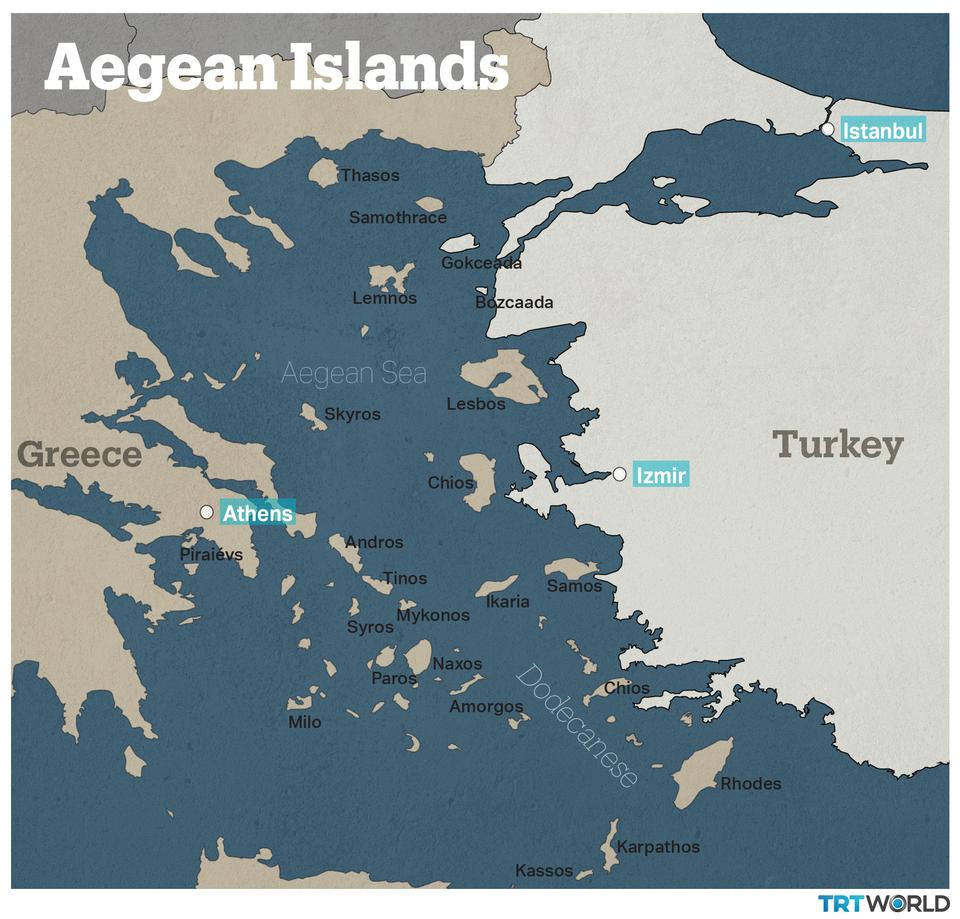 RUSSIA’S REACTION AGAINST GREECE'S HOSTILE BEHAVIORS AND VIOLATIONS OF THE DEMILITARIZATION PROVISIONS OF THE 1947 PARIS TREATY
Teoman Ertuğrul TULUN 29.12.2022
-
25.01.2016
THE ARMENIAN QUESTION - BASIC KNOWLEDGE AND DOCUMENTATION -
12.06.2024
THE TRUTH WILL OUT -
27.03.2023
RADİKAL ERMENİ UNSURLARCA GERÇEKLEŞTİRİLEN MEZALİMLER VE VANDALİZM -
17.03.2023
PATRIOTISM PERVERTED -
23.02.2023
MEN ARE LIKE THAT -
03.02.2023
BAKÜ-TİFLİS-CEYHAN BORU HATTININ YAŞANAN TARİHİ -
16.12.2022
INTERNATIONAL SCHOLARS ON THE EVENTS OF 1915 -
07.12.2022
FAKE PHOTOS AND THE ARMENIAN PROPAGANDA -
07.12.2022
ERMENİ PROPAGANDASI VE SAHTE RESİMLER -
01.01.2022
A Letter From Japan - Strategically Mum: The Silence of the Armenians -
01.01.2022
Japonya'dan Bir Mektup - Stratejik Suskunluk: Ermenilerin Sessizliği -
03.06.2020
Anastas Mikoyan: Confessions of an Armenian Bolshevik -
08.04.2020
Sovyet Sonrası Ukrayna’da Devlet, Toplum ve Siyaset - Değişen Dinamikler, Dönüşen Kimlikler -
12.06.2018
Ermeni Sorunuyla İlgili İngiliz Belgeleri (1912-1923) - British Documents on Armenian Question (1912-1923) -
02.12.2016
Turkish-Russian Academics: A Historical Study on the Caucasus -
01.07.2016
Gürcistan'daki Müslüman Topluluklar: Azınlık Hakları, Kimlik, Siyaset -
10.03.2016
Armenian Diaspora: Diaspora, State and the Imagination of the Republic of Armenia -
24.01.2016
ERMENİ SORUNU - TEMEL BİLGİ VE BELGELER (2. BASKI)
-
AVİM Conference Hall 24.01.2023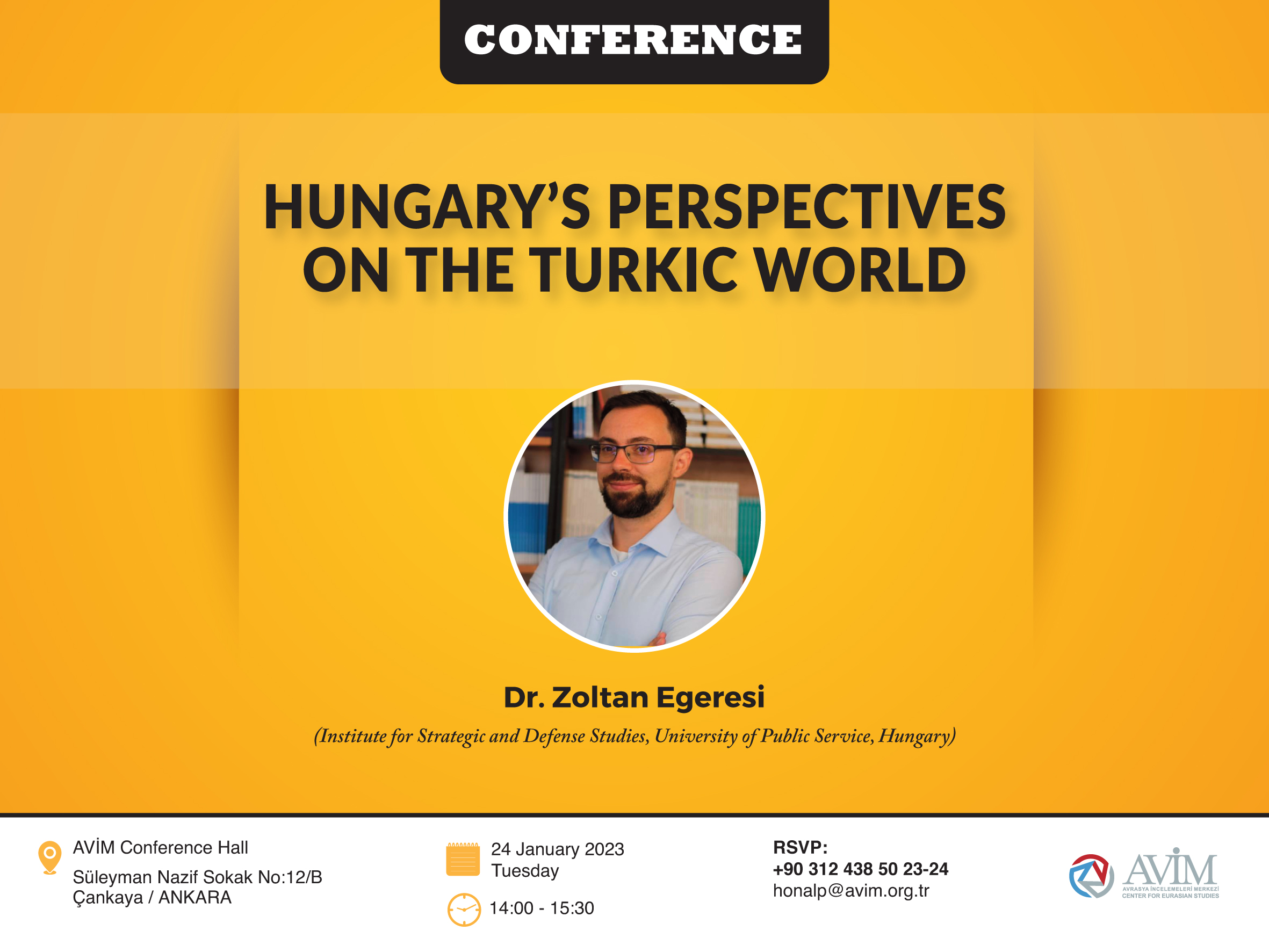
CONFERENCE TITLED “HUNGARY’S PERSPECTIVES ON THE TURKIC WORLD"