














As is known, the elections in Armenia have been concluded and Pashinyan emerged victorious, securing nearly half of the votes cast. The 49.8% of the vote obtained by Pashinyan granted the Civil Contract Party a total of 64 seats out of the 105-seat parliament.[1] Under these circumstances, the peace treaty process—which stands as one of the primary reasons for his electoral victory and has recently visibly restored Armenia’s prosperity and stability—along with the constitutional amendment, which is the final condition for its consummation, has come to the fore once again.
Article 202 of the Constitution of Armenia regulates the procedure to which constitutional amendments are subject. Pursuant to the relevant article, amendments to be made in certain sections of the constitution are contingent upon first achieving a 2/3 parliamentary majority, followed by a mandatory referendum. The second paragraph of Article 202 stipulates that for articles not specifically mentioned in the first paragraph, amendments can be made solely by a 2/3 majority of the parliament, without the requirement of a mandatory referendum. The third paragraph of the said article rules that in the event that an amendment cannot be passed through the procedure mentioned in the second paragraph, a referendum on the amendment in question may be initiated with a 3/5 majority of the members of parliament.[2]
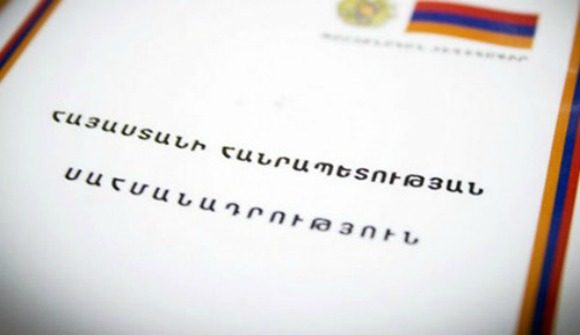
As can be inferred from the wording of Article 202, the procedures referred to therein apply to constitutional articles (Հոդված). Whether the preamble of the Constitution of Armenia may itself be regarded as an article remains a matter of controversy.[3] The 2015 Constitution, currently displayed on the website of the President of Armenia, names the preamble as Article 1, thereby giving the impression that there are two first articles.[4] Nevertheless, it is not possible to find a similar phrasing in any of the four constitutions (namely 1995, 2005, 2015, and 2020) featured on the Constitutional Court’s website.[5] The fact that a legal text cannot contain two first articles is self-evident.
The Constitutional Court’s Decision No. 1590, dated April 29, 2021, emphasizes that the preamble is among the provisions that cannot be amended and is therefore considered “immutable”.[6] Nevertheless, Article 203 of the Constitution, which regulates unamendable provisions, appears to provide an exhaustive list by expressly stating that only Articles 1, 2, 3, and 203 are not subject to amendment.[7] The Constitutional Court’s conclusion that the Preamble is likewise unamendable extends beyond the provisions enumerated exhaustively in the Constitution and, in doing so, gives rise to a constitutional interpretation problem with a predominantly political dimension. Although the source of this interpretation is considered to be the Constitution’s systematic structure and the reflection of Armenia’s political line in a primary legal text, when the current relations among regional countries and the peace treaty process are taken into account, it can be said that—even if not legally—it gives the impression of being de facto lacking in legitimacy.
The criticism of the Declaration of Independence in the preamble to the Constitution is based on the claim that Azerbaijani territories recognized under international law are part of Armenia.[8] The need to address this claim and to bring the parties’ bilateral relations—particularly the peace treaty process, which has reached a critical juncture—to a conclusion through a constitutional amendment is not a new demand. It is evident that the relevant Constitutional Court ruling issued following the Second Karabakh War, when the first steps of the peace process were taken, serves to block the legal avenues leading to a constitutional amendment.
In the Constitutional Court’s Decision No. 1749, dated September 26, 2024, it was stated that border changes do not constitute a violation of the Constitution. However, the relevant decision also refers to the aforementioned decision No. 1590. In this way, the Constitutional Court acknowledged that the preamble constitutes the core of the Constitution, that Article 203, which regulates the unamendable articles, should not be interpreted only literally, and that it is intended for values that must be protected.[9] In other words, even in an important decision that concerns the determination of legally recognized borders and constitutes an important part of the peace treaty process, the Constitutional Court did not change its political stance and insisted on its decision by evaluating the conditions of 2021 and 2024 in the same way.
The constitutional amendment issue for Armenia is not merely a fundamental legal obstacle resulting from Pashinyan winning 64 seats in the elections and the subsequent failure to achieve the 2/3 majority. Behind this obstacle, the views held by the core political and legal organs of the state form a wall that is difficult to overcome. In other words, according to the Constitutional Court, the preamble is already among the unamendable articles; if it is argued that this interpretation is absurdly broad and goes beyond the explicitly listed unamendable articles, then the question arises as to whether the preamble is considered an article due to the phrasing "articles" in the wording of Article 202. If the preamble is not evaluated as an article, then the majorities stipulated in Article 202 will lose their meaning, and there will be no specific legal majority required to amend the preamble. If the preamble is evaluated as an article, since it is not among the articles specified in the first paragraph of Article 202—which specifically require a referendum and a 2/3 parliamentary majority—it will be possible to go to a referendum with a 3/5 majority of MPs under the third paragraph, in cases where the approval majority (2/3) in the second paragraph cannot be met.[10] Given that there are 105 seats in the parliament, the Civil Contract Party holds 64 of these seats, and the 3/5 majority corresponds to 63 MPs, it appears legally possible for the constitutional amendment to proceed to a referendum.
As can be seen, there are many legal question marks and differences of interpretation regarding the constitutional amendment and the nature of the preamble. All of these differing interpretations require the utilization of other legal avenues, thereby leading to great uncertainty regarding the amendment. It is a fact that the long-standing positive stance of Pashinyan and other officials regarding the amendment has not eliminated these uncertainties. The amendment in question, which is paramount for finalizing the peace treaty, remains in need of clarification even after the elections.
Consequently, under today's conditions where the peace treaty is closest to being signed, it would not be correct to say that the Declaration of Independence forms the core of the Constitution of Armenia and lies at the foundation of the system. Due to its content, the Declaration of Independence stands directly opposed to the state of peace, prosperity, and stability that the treaty aims to achieve. Therefore, it is crucial that the interpretations to be made regarding the constitution and its amendment, as well as the legal procedures to be followed, lead to an outcome that aligns with the current conjuncture. For this reason, resolving the existing legal uncertainty and settling this matter as soon as possible in a way that paves the way for the signing of the treaty appears more important today than ever before.
*Image: Asbarez
[1] Tuğçe Tecimer, “Ermenistan’da 7 Haziran Seçimleri: Siyasi Süreklilik ve Bölgesel Dönüşüm”, AVİM, June 8, 2026, https://avim.org.tr/tr/Analiz/ERMENISTAN-DA-7-HAZIRAN-SECIMLERI-SIYASI-SUREKLILIK-VE-BOLGESEL-DONUSUM.
[2] Constitution of the Republic of Armenia, art. 202 (with amendments of June 22, 2020).
[3] As an example to the contrary, Article 175 of the Constitution of the Republic of Türkiye, which regulates constitutional amendments, literally governs not the procedure for amending the "articles" of the Constitution but rather the procedure for amending the "Constitution" itself, as illustrated by the following provision: "The deliberation and adoption of proposals for the amendment of the Constitution shall, save for the conditions set forth in this Article, be subject to the provisions governing the deliberation and adoption of laws."
[4] Constitution of the Republic of Armenia, (with amendments of December 6, 2015).
[5] Constitution of the Republic of Armenia, https://concourt.am/en/normative-legal-bases/constitution-of-ra/sahmanadrowt-yown-2020-t-vakani-hownisi-22-in-azgayin-zhoghovi-koghmits-endownvats-p-op-okhowt-yownnerov.
[6] Constitutional Court of the Republic of Armenia, Decision No. SDV-1590, April 29, 2021.
[7] Constitution of the Republic of Armenia, art. 203 (with amendments of June 22, 2020).
[8] “Armenian Declaration of Independence”, The Government of the Republic of Armenia, https://www.gov.am/en/independence.
[9] Constitutional Court of the Republic of Armenia, Decision No. DCC-1749, September 26, 2024.
[10] The same result is obtained when the provision of Article 202 is applied analogously to the preamble.
© 2009-2025 Center for Eurasian Studies (AVİM) All Rights Reserved
No comments yet.
-
 THE NORTH MACEDONIA-BULGARIA DISPUTE AND THE CONFUSING WAY EU DEALS WITH CHALLENGES
AVİM 12.01.2021 -
 GREEK FOREIGN MINISTER DENDIAS CONCEDES THE DEMILITARIZED STATUS OF THE EASTERN AEGEAN ISLANDS AND THE DODECANESE
Teoman Ertuğrul TULUN 14.03.2022 -
 ARMENIAN TERRORISM BEGINS TO SHOW ITS FACE AGAIN - 2
Hazel ÇAĞAN ELBİR 15.03.2021 -
 ARMENIAN ALLEGATIONS, LAW, AND POLITICAL LOBBYING
Gözde KILIÇ YAŞIN 26.05.2023 -
 BREXIT: NEW PARADIGM SHIFT FOR GLOBALIZATION AND SIGNAL FOR NEW WORLD ORDER
Teoman Ertuğrul TULUN 27.01.2017
-
25.01.2016
THE ARMENIAN QUESTION - BASIC KNOWLEDGE AND DOCUMENTATION -
12.06.2024
THE TRUTH WILL OUT -
27.03.2023
RADİKAL ERMENİ UNSURLARCA GERÇEKLEŞTİRİLEN MEZALİMLER VE VANDALİZM -
17.03.2023
PATRIOTISM PERVERTED -
23.02.2023
MEN ARE LIKE THAT -
03.02.2023
BAKÜ-TİFLİS-CEYHAN BORU HATTININ YAŞANAN TARİHİ -
16.12.2022
INTERNATIONAL SCHOLARS ON THE EVENTS OF 1915 -
07.12.2022
FAKE PHOTOS AND THE ARMENIAN PROPAGANDA -
07.12.2022
ERMENİ PROPAGANDASI VE SAHTE RESİMLER -
01.01.2022
A Letter From Japan - Strategically Mum: The Silence of the Armenians -
01.01.2022
Japonya'dan Bir Mektup - Stratejik Suskunluk: Ermenilerin Sessizliği -
03.06.2020
Anastas Mikoyan: Confessions of an Armenian Bolshevik -
08.04.2020
Sovyet Sonrası Ukrayna’da Devlet, Toplum ve Siyaset - Değişen Dinamikler, Dönüşen Kimlikler -
12.06.2018
Ermeni Sorunuyla İlgili İngiliz Belgeleri (1912-1923) - British Documents on Armenian Question (1912-1923) -
02.12.2016
Turkish-Russian Academics: A Historical Study on the Caucasus -
01.07.2016
Gürcistan'daki Müslüman Topluluklar: Azınlık Hakları, Kimlik, Siyaset -
10.03.2016
Armenian Diaspora: Diaspora, State and the Imagination of the Republic of Armenia -
24.01.2016
ERMENİ SORUNU - TEMEL BİLGİ VE BELGELER (2. BASKI)

-
AVİM Conference Hall 24.01.2023
CONFERENCE TITLED “HUNGARY’S PERSPECTIVES ON THE TURKIC WORLD"