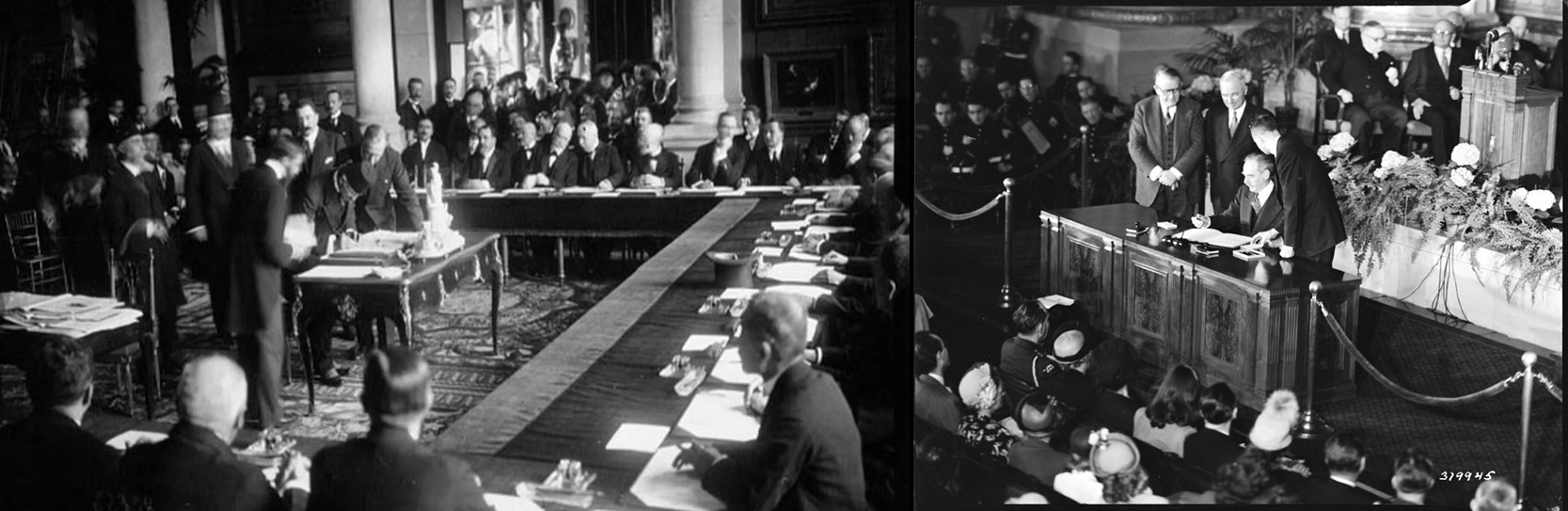
The Preamble of the 1936 Montreaux Convention starts with the following sentence: “Desiring to regulate transit and navigation in the Straits of the Dardanelles, the Sea of Marmora and the Bosphorus comprised under the general term ‘Straits’ in such manner as to safeguard, within the framework of Turkish security and of the security, in the Black Sea, of the riparian States,..” Accordingly, the 1936 Montreux Convention established a special regime for the Turkish Straits that combines freedom of passage for merchant vessels with far-reaching rights and responsibilities for Türkiye to control and regulate military and naval access to and from the Black Sea. In both peace and war, it is Türkiye that supervises and implements these rules, including the power to restrict or close the Straits under defined conditions, thereby grounding its gatekeeping role legally and making it non-delegable.[1]
In this context, it should be emphasized that, according to this treaty-based framework, Türkiye has neither the need nor the legal obligation to share the implementation of the Straits regime with a single state or a broader coalition of states. Taken together, any new initiative that could lead to a permanent reshaping of the Black Sea region must begin not with politically and militarily convenient shortcuts or informal reinterpretations, but with the explicit recognition of Türkiye's treaty-based responsibilities and the institutional structure that already binds the region.
Recently, various press reports indicated that the NATO Multinational Corps Headquarters (MNC-TÜR) is being established within the 6th Corps, based in Adana, and that Turkish officers have been appointed to its core staff. In connection with this news, it has also been highlighted that a Naval Component Command is planned to be established in Anadolu Kavağı, Beykoz, Istanbul, on the Black Sea section of the Bosphorus, as part of the "Ukrainian Volunteer Coalition." The establishment of this Naval Component Command and its future NATO-related activities have become subjects of debate due to their potential connection to the 1936 Montreux Convention.
Regarding the discussions on this issue, the Spokesperson of the Ministry of National Defense made a statement at the weekly press briefing and provided detailed information regarding the Naval component command.[2] In this context, he stated that, in accordance with NATO's Defense and Deterrence Concept, changes have been made to the planning and command-and-control systems since 2020 to deter threats, facilitate the transition to defense, and strengthen defenses against attacks on NATO territory. Strategic and regional plans have been prepared. The establishment of headquarters to implement these plans is foreseen. He further stated that, within this framework, activities have begun to establish the Multinational Corps Headquarters-Türkiye (MNC-TÜR) in 2023 and the Combined Task Force (CTF) Black Sea in 2024.
The command and hosting of the CTF-Black headquarters to be established in the Black Sea will be undertaken by Türkiye until 2028. The country that will host and command the said headquarters after 2028 will be determined based on proposals from the Black Sea littoral allies (Romania and Bulgaria), and on the continuation of headquarters establishment activities. Only core personnel assignments have been made.
As a separate heading, Spokesperson also dealt with the Ukrainian Volunteer Coalition Marine Command (MCC) and stated that the "Ukrainian Volunteers Coalition," a multinational initiative not affiliated with NATO, is currently planning security arrangements should the Russia-Ukraine War end by agreement, and 33 countries have already expressed their desire to participate. Türkiye will lead the Maritime Component Command (MCC) of this force to maintain security and stability, upholding the principle of regional ownership, and preserving the balance established by the Montreux Convention on the Strait. In this regard, at the meeting held in Ankara on April 15-16, 2025, it was agreed that Türkiye will continue to lead planning activities in the maritime dimension and that the legal framework established by the Montreux Convention on the Straits will be the basis for these plans. He further clarified that the Naval Component Command Headquarters was established on August 25, 2025, with a core staff composed entirely of Turkish personnel, and while 14 countries have declared their support for the Naval Component Command, contributions to naval platforms will only be provided by the coastal states of Türkiye, Romania, and Bulgaria.
These statements reveal that detailed studies of the Black Sea are being conducted by both NATO and the Ukrainian Volunteer Coalition. The emphasis on regional belonging in these studies is undoubtedly significant. Within this framework of regional belonging, Türkiye's central role is inevitable. In particular, in studies that appear to have begun within the NATO framework, Türkiye's rights and obligations under the Montreux Convention cannot be transferred to or shared with any country or group of countries, even within NATO. Specifically, the transfer of command of a new military structure planned for establishment at the mouth of the Bosphorus Strait, even if it were a Black Sea coastal state, to a NATO country is unthinkable, not only until 2028 but also after 2028. Extreme caution is necessary in this regard. Even if such a command were transferred to a country other than Türkiye after 2028, any responsibility under the Montreux Convention regarding passage through the Bosphorus could not be shared with this new structure. This issue cannot be addressed solely from a military-necessities-and-security perspective. Discussions on this matter must take place at the political and diplomatic levels, with the participation of international law experts.
Türkiye’s approach to both NATO-related Black Sea planning and the Ukrainian Volunteer Coalition must remain firmly anchored in the Montreux Convention. As the guardian and implementing authority of the Straits regime, Türkiye cannot transfer, share, or dilute its treaty-based responsibilities with any other state or structure, regardless of operational convenience or alliance preferences. Any such initiative must therefore be pursued in a manner consistent with Türkiye’s national and international legal obligations. The establishment of any new military command near the Bosphorus must therefore be assessed not only through a security lens, but also with full regard to Türkiye’s legal obligations, national interests, and the delicate balance of the Black Sea order. Any discussions on this matter should be conducted carefully at the political and diplomatic levels, with the participation of international law experts, to avoid actions that could jeopardize Türkiye’s rights and the stability preserved by the Montreux framework.[3]
*Picture: AVİM
© 2009-2025 Center for Eurasian Studies (AVİM) All Rights Reserved
















 WHERE IS KAZAKHSTAN HEADED IN THE MIDDLE EAST AND THE EASTERN MEDITERRANEAN?
 THE NEW LEGAL BASIS FOR EU-ARMENIA RELATIONS
 URGENT NEED TO STRENGTHEN THE EFFECTIVE IMPLEMENTATION OF THE BIOLOGICAL WEAPONS CONVENTION
 CONSTRUCTIVE EURASIANISM AND PAST REFLECTIONS
 JOE BIDEN’S STATEMENT ON 1915 EVENTS: PURPOSEFUL POLITICAL ACTIONS MAY CAUSE UNANTICIPATED CONSEQUENCES, AN ANALYSIS FROM THE SOCIOLOGICAL VIEWPOINT
 CAN "NORTHERN MACEDONIA" SOLVE THE PROBLEM?
 AMERICA ON THE WANE: THE HOUSE OF REPRESENTATIVES DISGRACES ITSELF AND LOSES CREDIBILITY
 CALL FOR PAPERS: REVIEW OF ARMENIAN STUDIES
 THE AZERBAIJAN-ARMENIA PEACE PROCESS AND THE IMPACTS OF LOBBIES