













Review Of Armenian Studies - Sayı / Issue: 53
Editor's Note
Editor's Note
This 53rd issue of the Review of Armenian Studies appears at a moment of exceptional historical significance for the South Caucasus, a conjuncture in which the long-deferred promise of regional peace is transforming from diplomatic aspiration into institutional reality. At the same time, Armenia’s fundamental geopolitical orientation and civilizational identity are being openly negotiated and redefined. The Facts and Comments section chronicles the pivotal developments of December 2025 through May 2026, a period punctuated by landmark events: the first-ever EU–Armenia Summit held in Yerevan on 5 May 2026, the hosting of the 8th European Political Community Summit on Armenian soil, the holding of parliamentary elections on 7 June 2026 that returned Prime Minister Pashinyan’s Civil Contract party to power—albeit short of a constitutional supermajority—and the continued, if still unfinalized, trajectory of the Armenia–Azerbaijan peace process toward its historic conclusion. Against this backdrop of simultaneous transformation and fragility, the contributions to this volume engage with the deeper structural, historical, and legal dimensions of the questions that these dramatic developments both illuminate and, in certain respects, have yet to
resolve fully.
The normalization process between Türkiye and Armenia continues to advance along a constructive, if measured, path. The attendance of Turkish Vice President Cevdet Yılmaz at the Yerevan summits of May 2026—and his characterization of Türkiye–Armenia normalization as “extremely valuable” and “an example and inspiration for others”—reflects a broadly shared regional recognition that the architecture of post-conflict cooperation is actively being constructed. The 8th European Political Community Summit, the first to be hosted outside Europe’s traditional geographic core, placed Armenia emphatically at the center of continental diplomacy and was accompanied by the launch of an EU–Armenia Connectivity Partnership and the establishment of a new EU Partnership Mission in Armenia. Meanwhile, Foreign Minister Hakan Fidan has reaffirmed Türkiye’s consistent position, linking the full opening of borders and normalization to the signing of a final
Armenia–Azerbaijan peace treaty—with work on the Kars–Gyumri railway connection, the restoration of the Ani Bridge, and bilateral trade infrastructure continuing in anticipation of that moment. It is within this rich and rapidly evolving regional environment that the scholarly contributions of this issue
must be read.
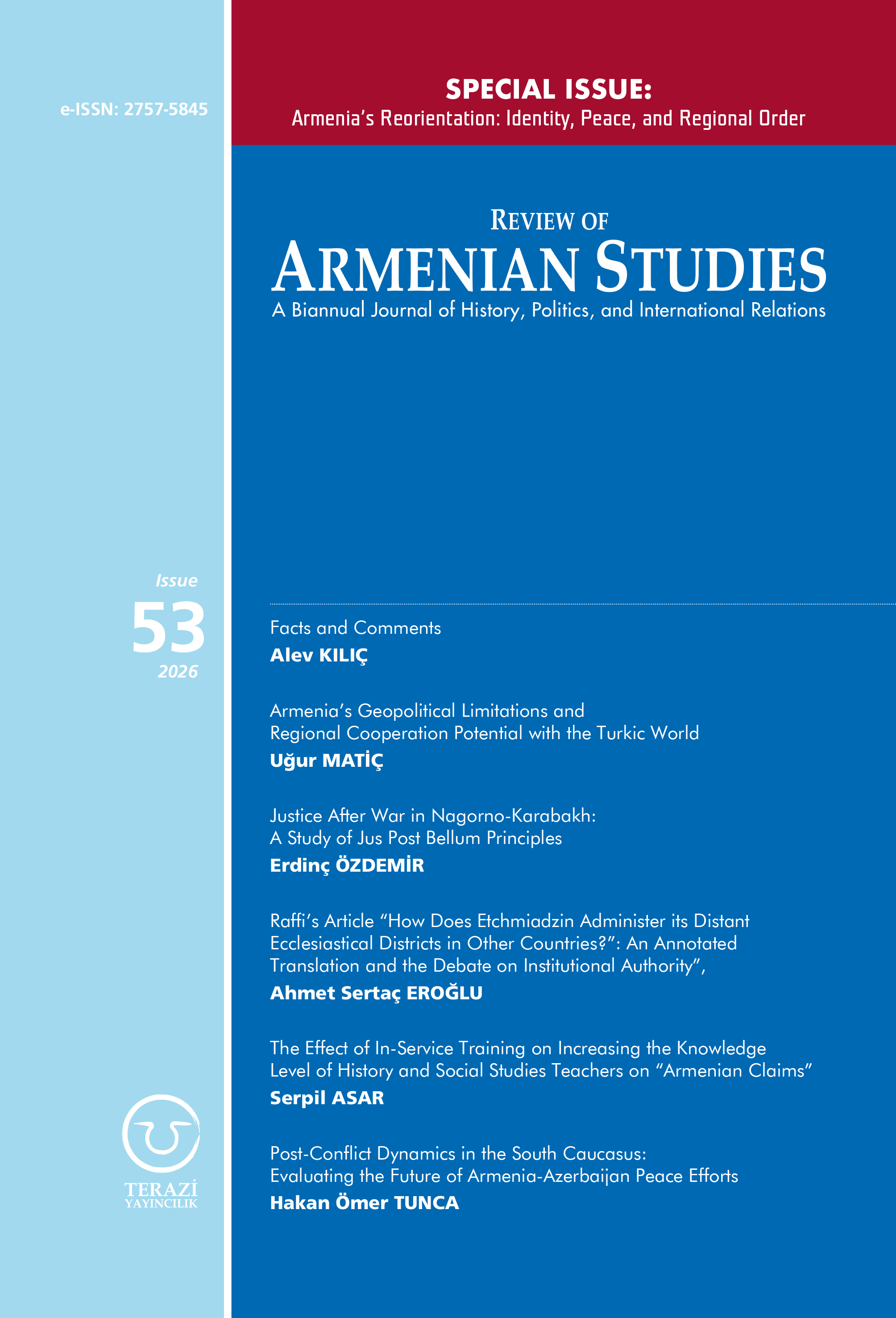
The special issues title will be Armenia’s Reorientation: Identity, Peace, and Regional Order.
The defining theme of the present moment in the Armenian question is not simply peacemaking between states; it is a far more fundamental renegotiation of Armenian national identity, regional belonging, and geopolitical selfconception. Prime Minister Pashinyan’s government has, with unusual candor, renounced what his predecessors treated as inviolable historical narratives, instead staking its political future on a platform of normalization, regional integration, and Euro-Atlantic openness. The June 2026 parliamentary elections, resulting in a Civil Contract victory that nonetheless fell short of the two-thirds qualified majority needed to call the constitutional referendum long demanded by Baku as a precondition for finalizing the peace treaty— illustrate both the breadth of this reorientation and its political limits. Armenia’s formal application for European Union membership, backed by arliamentary decision since April 2025 and affirmed at the highest levels
during the historic EU–Armenia Summit, marks a civilizational pivot of the first order. Yet this pivot is not frictionless: the Apostolic Church, significant segments of the diaspora, and pro-Russian opposition forces continue to contest its terms, framing the normalization agenda as a betrayal of national aspirations. The four articles of this special section engage directly with these realities, examining identity construction, peace-process dynamics, postconflict justice, and ecclesiastical governance as interconnected dimensions of Armenia’s ongoing transformation.
Alev Kılıç’s Facts and Comments covering December 2025 through May 2026 map the full complexity of this conjuncture with analytical precision. Tracing the interplay between Armenia’s accelerating westward reorientation, the evolving peace process with Azerbaijan, the church–state cleavage that structured the June 2026 electoral contest, and Türkiye’s supportive yet conditioned posture, Kılıç demonstrates that the Armenian elections functioned as far more than a domestic political event—they were, in effect, a referendum on a civilizational choice. The broad, visible support of the EU and the United States for Pashinyan’s platform confronted a churchbacked, diaspora-supported conservatism that drew on the very historical narratives the government has sought to set aside. Kılıç’s analysis reveals the structural tension between the imperatives of regional peace and the enduring gravitational pull of historical grievance, offering an indispensable contextual frame for all the scholarly contributions that follow.
Uğur Matiç’s article examines Armenia’s geopolitical limitations through the prism of identity construction and the systematic “othering” of Türkiye and the broader Turkic world. By analyzing how the designation of Türkiye as the constitutive “other” has functioned as a structuring constraint on Armenian foreign policy and regional cooperation—despite deep historical and cultural affinities—Matiç argues that the diplomatic opportunities opened by the Second Karabakh War and its aftermath create a genuine, if still fragile, opening for Armenia to reposition itself as a potential bridge between Turkic Central Asia and Europe. The proposal for observer status for Armenia within the Organization of Turkic States is advanced not as a utopian aspiration but as a strategic lever to encourage a reorientation of Armenian foreign policy beyond the limiting framework of ontological insecurity. This contribution is, in a very real sense, a meditation on what the ongoing normalization process means for Armenia’s understanding of its own place in the regional order.
Erdinç Özdemir’s rigorous application of jus post bellum principles to the Nagorno-Karabakh context offers a critical corrective to the dominant assumption that peace follows inevitably from the cessation of armed conflict. By examining the ethical, legal, and institutional dimensions of post-conflict justice—accountability, reconciliation, reconstruction, reparation, and border demarcation—Özdemir demonstrates that a durable settlement requires far more than a diplomatic instrument. This study provides the normative framework through which the current peace process must be assessed.
Hakan Ömer Tunca’s systematic thematic content analysis of post-conflict diplomatic discourse—drawing on UN General Assembly speeches, OSCE and EU mediation documents, bilateral and trilateral communications, and treaty texts—provides an important empirical complement to Özdemir’s normative analysis. Tunca’s finding that formal diplomatic discourse in the South Caucasus has undergone a marked shift between 2023 and 2025, with connectivity and treaty-related themes increasingly displacing earlier preoccupations with sovereignty and security, constitutes a significant contribution to our understanding of the region’s evolving diplomatic culture. The displacement of memory-centric narratives by a technocratic, forwardlooking discourse focused on borders, infrastructure, and regional cooperation resonates directly with the political choices being made in Yerevan, Baku, and Ankara. It signals a broader transformation in the region’s conceptual architecture of peace.
Ahmet Sertaç Eroğlu’s annotated translation of Raffi’s celebrated 1879 article in Mshak on Etchmiadzin’s governance of its distant ecclesiastical jurisdictions offers historical lens of striking contemporary relevance. At a moment when the divide between the Catholicos and the Pashinyan government has emerged as one of the structuring axes of Armenian domestic politics, Raffi’s nineteenth-century critique of institutional religious corruption, of the erosion of ecclesiastical authority, and of the consequences of such erosion for national cohesion reads as an unexpectedly timely text. The article’s argument—that the weakening of Etchmiadzin’s capacity for governance constitutes a structural obstacle to national unity and awakening—resonates powerfully with contemporary debates about the church’s role in contesting or legitimizing Armenia’s geopolitical reorientation. By demonstrating how religion and nationalism have long been entangled as both mutually reinforcing and mutually destabilizing forces in Armenian political life, this contribution essentially broadens the historical horizon of the issue.
Serpil Asar’s experimental study on the effect of in-service training on history and social studies teachers’ content knowledge of “Armenian Claims” complements the special section with a methodologically rigorous empirical investigation of a domain underexplored in the existing literature. Using a pre-test/post-test control group design, Asar examines whether the Ministry of National Education’s provincial seminar program produces measurable improvements in teachers’ field knowledge of the subject, finding a statistically significant increase in the experimental group relative to the control group. The study raises important questions about the relationship between formal pedagogical intervention, teacher preparedness, and the broader discursive environment in which the Armenian question is understood, taught, and transmitted across generations. This contribution bridges the journal’s historical and policy concerns with the domain of educational research, adding a dimension that enriches the volume’s overall analytical scope.
As the South Caucasus undergoes its most consequential transformation since the dissolution of the Soviet Union, and as Türkiye’s role as a constructive actor committed to regional stability, connectivity, and peace becomes ever more visible, this 53rd issue of the Review of Armenian Studies remains committed to the rigorous, evidence-based, and multidisciplinary scholarship that has distinguished the journal since its inception. We extend our sincere gratitude to all contributors for the precision, depth, and intellectual integrity of their analyses, and we trust that this volume will serve as a valuable resource for scholars, policymakers, and all those engaged with the enduring and evolving dimensions of the Armenian question in its regional and global context.
Index
Authors