













Review Of Armenian Studies - Sayı / Issue: 52
Editor's Note
Editor's Note
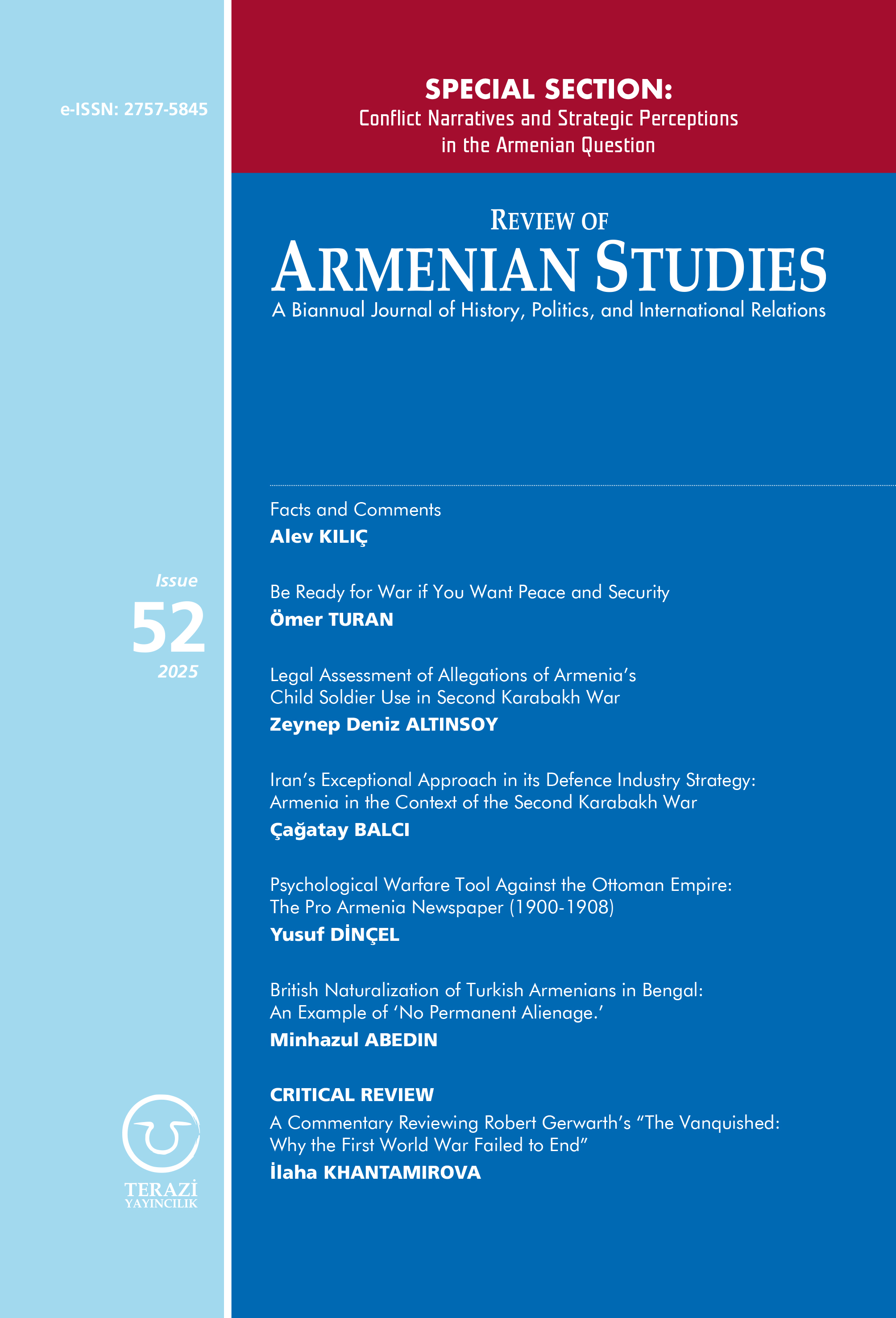
This 52nd issue of the Review of Armenian Studies appears at a time of renewed movement in the complex trajectory of Armenia’s domestic and international orientation. The Facts and Comments section chronicles notable shifts of June–November 2025, highlighting the dynamic interplay between domestic contestation, diaspora engagement, and international diplomacy. The normalization efforts between Armenia and Türkiye, together with progress in the Armenia-Azerbaijan peace negotiations, frame this edition’s multidisciplinary contributions.
Building on the editorial innovations of previous volumes, we retain the Commentary Section, this time examining the perennial resonance of the Armenian issue within Turkish politics and diplomacy. Prof. Dr. Ömer Turan’s essay explores the transition of the “Armenian question” from diplomacy to public debate, emphasizing the critical significance of normalization efforts in the aftermath of the Karabakh conflict.
The centerpiece of this volume is the special section “Conflict Narratives and Strategic Perceptions in the Armenian Question.” Here, contributors address the intersection of war, law, propaganda, and security:
Assist. Prof Dr. Zeynep Deniz Altınsoy evaluates the legal foundation and international implications of Azerbaijan’s accusations regarding the use of child soldiers by Armenia in the Second Karabakh War, highlighting the nuances of international law and challenges of evidence.
Dr. Çağatay Balcı analyzes Iran’s shifting defense industry strategy within the context of the Karabakh conflict, tracing an “exceptional approach” that signals broader regional transformation.
Assist. Prof. Yusuf Dinçel assesses the Pro Armenia newspaper’s role as a tool of psychological warfare in the late Ottoman era, offering a revealing look at propaganda, perception management, and the international context shaping discourse on the Armenian question.
Complementing these studies, PhD Candidate Minhazul Abedin’s article on the British naturalization of Turkish Armenians in Bengal highlights the transnational legal and identity evolution of diaspora communities, broadening our understanding of citizenship and mobility beyond the immediate regional conflicts.
Finally, Dr. İlaha Khantamirova’s critical review of Robert Gerwarth’s, a commentary reviewing Robert Gerwarth’s, “The Vanquished: Why the First World War Failed to End” critiques the Eurocentric limitations of seminal postwar historiography, calling for greater engagement with Ottoman and Turkish sources to achieve balanced, multi-perspective analyses.
As regional actors explore normalization and peace, this issue remains committed to the rigorous, evidence-based scholarship and multidisciplinary analysis that have been core characteristics of the Review of Armenian Studies since its inception. We thank our contributors for deepening our insight into the region’s enduring challenges and hope this edition inspires further informed dialogue and research.
Index
Contents
Contributors. Review of Armenian Studies 51 (2025): 6.
Editorial Note. Review of Armenian Studies 51 (2025): 9.
Articles
Kılıç, Alev. "Facts and Comments." Review of Armenian Studies 52 (2025): 13.
Commentary Sections
Special Sections: CONFLICT NARRATIVES AND STRATEGIC PERCEPTIONS IN THE ARMENIAN QUESTION
Altınsoy, Zeynep Deniz "Legal Assessment of Allegations of Armenia’s Child Soldier Use in Second Karabakh War." Review of Armenian Studies 52 (2025): 75.
RESEARCH ARTICLE
Critical Review
Authors
Ambassador (R) Alev KILIÇ graduated from the Faculty of Political Sciences of Ankara University in 1968. The next year, he joined the Ministry of Foreign Affairs of Türkiye. Kılıç served as Ambassador to F.R. of Yugoslavia between 1996 and 1998 and Ambassador/Permanent Representative to the Council of Europe in Strasbourg between 1998 and 2001. In 2001-2004, he served as the Deputy Undersecretary for Economic Affairs of the Ministry. He served as Ambassador to Switzerland (2004-2009) and Ambassador to Mexican United States (2009-2011). He retired from the Ministry in 2011. Ambassador (R) Kılıç has been the Director of Center for Eurasian Studies (AVİM) since 2013.
Prof. Dr. Ömer TURAN got his bachelor and MA degrees from Ankara University in Türkiye, and his second MA and PhD degrees from Leuven Catholic University in Belgium. He is a professor at History Department of Middle East Technical University. He served as the chair of History Department of METU (2013-2020, 2023-2025) and Campus President of METU Northern Cyprus Campus (2020-2021). He was a visiting professor at Princeton and William Paterson universities in the US (2008-2011). He taught Ottoman and Turkish history. He works on the nineteenth and twentieth centuries Ottoman and Turkish History; minorities, nationalism and missionary activities in the Balkans, Anatolia, Caucasus and the Middle East in the same period. He has got books and articles on these subjects. Some of his books are The Turkish Minority in Bulgaria, 1878-1908 (Turkish Historical Society, Ankara, 1998), Avrasya’da Misyonerler (ASAM, Ankara, 2002), Balkanlar’da Türk Eserlerinden Örnekler (co-author, Turkish Grand National Assembly, Ankara, 2004), Ermeniler: Sürgün ve Göç (co-author, Turkish Historical Society, Ankara, 2004), The Armenian Rebellion of Van (co-author, The University of Utah Press, Salt Lake City, 2006), The Ottoman Russian War of 1877-1878 (ed., Middle East Technical University & Meiji University, Ankara, 2007), A History of an 1890s Armenian Revolt, Sasun, (co-author, The University of Utah Press, Salt Lake City, 2014), Osmanlı’dan Cumhuriyet’e
Yozgat’tan Çorum’a Hayatımın Hatıraları (ed. Ankara Üniversitesi, 2025, Ankara).
Zeynep Deniz ALTINSOY, Assist. Prof. Dr. at Bilecik University. Her research has been in the fields of International Public Law such as International Criminal Law, the Law of War, Maritime Law, and Refugee Law; her studies have been in the fields of international relations such as Ethnicity Nationalism, Russian Foreign Policy, and Theories. She graduated from Anadolu University International Relations Department. She completed his law education at International Vision University; and received
his doctorate degree from Kırıkkale University International Relations Department. She has served as coordinator for various think-tanks.
Çağatay BALCI he graduated from the Department of International Relations at the Faculty of Economics and Administrative Sciences, Selçuk University, in 2015. In 2018, he completed a Master’s degree in Intelligence Studies at the Police Academy Institute of Security Sciences, writing his thesis on the topic of ‘Intelligence Structure in the Islamic Republic of Iran’. In 2023, he completed his doctoral studies in the International Security and Terrorism Programme at the Alparslan Defence Sciences and National Security Institute of the National Defence University. He currently works as a researcher at the Centre for Iranian Studies (İRAM), focusing on Iran’s regional policies, security structures, relations with nonstate
armed actors, and strategic communication activities.
Minhazul ABEDIN is a Bangladeshi scholar with a deep academic background in history. He graduated from the Faculty of Arts at Dhaka University and later completed his master’s thesis at Marmara University, focusing on “Haji Shariatullah and the Faraizi Movement.” Currently, he is pursuing his PhD at the Department of Post-Modern History at Istanbul University, where his research centers on “Anti-British Colonial Movements and Ottoman/Turkish Perception in Bengal (1877-1947).” His areas of expertise encompass the history of Bengal and the Indian subcontinent, the modern history of the Muslim world, and the historical relations between Türkiye and Bengal. Minhazul is dedicated to exploring the dynamic interplay between South Asian and Ottoman histories, particularly in the context of colonial resistance and the influence of Ottoman thought on Bengali anti-colonial movements.
Yusuf DİNÇEL got his bachelor’s degree from International Relations department of Ankara University. He took his master’s degree with his thesis “ ‘Small Ally’ In the Grip of Great Powers: Nestorians During and After the First World War” from International Relations department of TOBB University of Economics and Technology. Yusuf Dinçel has finished his PhD in International Relations at Hacettepe University. He worked as an analyst on security issues at the Presidency of the Republic of Türkiye. He is currently a Assist. Prof. Dr. in the field of International Security at the Turkish National Police Academy. His research areas focus on intelligence, history of intelligence, and Middle East.
İlaha KHANTAMIROVA graduated from the Department of History at Baku State University in 2008. In 2012, she received her master’s degree from the same university. In 2023, she earned her Ph.D. from the Institute of Social Sciences at Akdeniz University with her dissertation titled “The Issue of Political and Cultural Unity of the Russian Turks in the Azerbaijani National Press (1905–1907).” Her research focuses on the History of Azerbaijan, the South Caucasus,Turks of Russia and History of Russia. Since May 2025, she has been serving as a Scholar in Residence at AVİM.